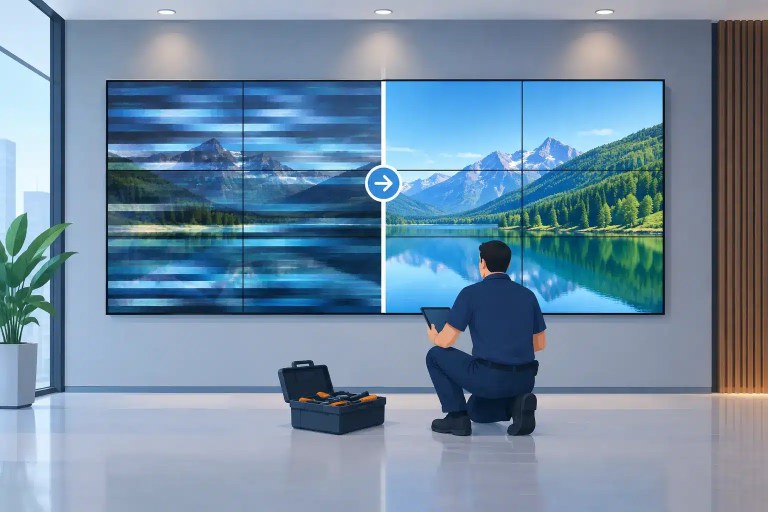
A dark cabinet at load-in is rarely just a cosmetic issue. It can hold up a build, reduce usable rental inventory, or create a visible failure point in a high-stakes presentation. The cabinet swap vs bench repair decision is therefore not simply about the fastest available fix. It is about restoring service quickly while making sure the actual fault does not return on the next show.
For professional LED operators, both approaches have a place. A cabinet swap protects immediate uptime when a compatible spare is available. Bench repair determines why the failure happened and returns the affected asset to inventory with a documented repair and final test.
What a Cabinet Swap Actually Solves
A cabinet swap means removing a failed LED cabinet from the wall and replacing it with a matching, tested cabinet. In rental and live-event environments, this is often the correct operational move. The wall can be rebuilt, calibrated as needed, and returned to service without asking the crew to troubleshoot electronics on the show floor.
The replacement cabinet must be genuinely compatible. That includes pixel pitch, cabinet dimensions, mechanical locking system, LED batch characteristics, scan configuration, receiving card setup, brightness behavior, calibration data, and firmware requirements. A cabinet that physically fits but does not match color, grayscale response, or processing configuration can create a new problem in the middle of the wall.
A swap is especially useful when the failed cabinet has obvious physical damage, intermittent behavior that cannot be safely isolated during setup, or a fault that threatens the schedule. It gives the production team time to keep moving. It does not, however, establish whether the original problem came from the cabinet itself, a module, a power supply, a receiving card, a signal path, or an external system issue.
Cabinet Swap vs Bench Repair: The Real Difference
The practical difference is purpose. A cabinet swap is an uptime strategy. Bench repair is a diagnostic and restoration strategy.
At the bench, a technician can inspect the entire cabinet under controlled conditions. That process may include checking module behavior, power rails, cable integrity, receiving card operation, connector condition, driver IC performance, damaged traces, solder joints, and PCB-level faults. It also allows the technician to reproduce intermittent failures that may not appear during a quick field test.
This matters because a visible LED issue does not always identify the failed component. A line of dead pixels may point to a failed driver IC, but it can also result from a damaged data path, a bad connector, a compromised module PCB, or an upstream signal issue. Color shifts, flicker, random artifacts, and partial module failures can have similarly different causes.
Replacing the whole cabinet may get the wall working, but it can leave a repairable asset sidelined and an unresolved pattern of failure in the fleet. Bench repair is where the organization learns whether it has a one-off incident or a recurring technical problem.
When a Cabinet Swap Is the Right Call
A cabinet swap is usually the right choice when time on site is limited and the defective cabinet can be isolated with confidence. For a touring wall, corporate general session, casino display, or trade show installation, protecting the show schedule often outweighs any benefit of field-level disassembly.
It is also appropriate when the replacement cabinet has already been tested and matched to the deployed system. A prepared spare program gives crews a controlled recovery path rather than forcing a rushed decision under production pressure.
The strongest cabinet-swap workflows include a clear quarantine process. Once removed, the failed cabinet should be labeled with the date, venue or job reference, observed symptoms, wall position, and any known conditions such as impact damage, moisture exposure, power events, or signal loss. This information gives the repair technician a much better starting point than a cabinet arriving with only a note that says it is bad.
Swapping a cabinet repeatedly without sending it through diagnosis can create avoidable inventory losses. Over time, repairable cabinets accumulate in storage, spare stock becomes thinner, and operators may buy replacement inventory before they understand what can be restored.
When Bench Repair Is the Better Investment
Bench repair is the better path when the cabinet is not catastrophically damaged and replacement is expensive, unavailable, or operationally impractical. It is also the appropriate next step after a field swap, because it returns the removed asset to usable inventory rather than treating it as a write-off.
Component-level repair can address failures that do not require a full cabinet or module replacement. Depending on the diagnosis, work may involve pixel repair, LED replacement, driver IC replacement, PCB trace repair, connector repair, receiving card troubleshooting, precision soldering, or correction of prior repair damage. The right repair depends on the actual fault, not the first visible symptom.
Bench work is particularly valuable for recurring issues. If several cabinets show the same horizontal line, color anomaly, or intermittent module behavior, replacing each cabinet independently may hide a common cause. A documented evaluation can reveal whether the issue is tied to a production batch, handling damage, a particular module position, power condition, receiving card configuration, or another repeatable failure mode.
For fixed installations, bench repair can also be less disruptive than trying to replace a cabinet with a different manufacturing revision. A repaired original cabinet may preserve mechanical fit, visual consistency, and system compatibility that a newer replacement cannot guarantee.
Do Not Diagnose the Cabinet in Isolation
A cabinet that appears faulty may be responding to a problem elsewhere in the signal or power chain. Before authorizing repair or replacement, confirm the symptoms with known-good connections and, where possible, a known-good cabinet in the same position.
If the failure follows the cabinet, the cabinet is the primary suspect. If it remains in the same wall position after the cabinet changes, examine the data cable, power feed, receiving card configuration, processor mapping, output port, or upstream source. This simple isolation step prevents good cabinets from being sent out for repair and keeps processor or distribution issues from being misidentified as module failures.
The same principle applies to intermittent issues. Heat, movement, load, transport vibration, and connector stress can change the behavior of a cabinet. Recording when the issue occurs is useful technical evidence, especially when the fault cannot be reproduced immediately at the bench.
A Practical Decision Process for Operations Teams
Start with the event or operational requirement. If the wall must be restored now and a verified spare is available, swap the cabinet. If there is time to investigate before deployment, or no compatible spare exists, send the unit through a structured diagnostic process first.
Next, consider the cabinet’s condition and history. A cabinet with severe structural damage, water contamination, or repeated failure may need a different disposition than a cabinet with a localized pixel or data issue. The value of repair should be measured against the cost and availability of a truly compatible replacement, not only against the price of a single repair ticket.
Finally, consider fleet health. A rental house with dozens of similar cabinets benefits from knowing how many units are in active service, quarantine, repair, and final QC. That information supports purchasing decisions, spare ratios, maintenance planning, and realistic deployment commitments.
What Good Bench Repair Documentation Looks Like
The repair record should connect the reported symptom to the verified fault and the corrective work performed. It should also record relevant testing results rather than only stating that the cabinet powers on.
For professional LED inventory, useful documentation may include the cabinet identification, incoming condition, diagnostic findings, parts or components replaced, repair method, calibration or configuration checks, and final test results. Where applicable, photos of impact areas, damaged pads, connector issues, or board-level work can be valuable for asset history and internal accountability.
Final QC should test the behavior that matters in service: uniform image performance, pixel operation, color output, stability, data integrity, power behavior, and physical integrity. A cabinet can pass a basic power-up check while still having intermittent faults that surface after installation, transport, or extended runtime.
725Co. applies this repair-first discipline through component-level diagnostics, precision repair, and documented final testing. With 14 years of experience supporting professional AV organizations, including teams such as Freeman, 4Wall, and PRG, the focus is not simply on returning a cabinet that lights up. The objective is to identify the failure correctly and return an asset that has been evaluated for reliable professional use.
Build the Workflow Before the Next Failure
The best time to decide between a cabinet swap and bench repair is before a wall is under show pressure. Maintain tested, compatible spares; label cabinets clearly; record recurring symptoms; and establish a quarantine path that moves failed units into diagnosis instead of leaving them in uncertain storage.
When a cabinet fails, restore the wall with the least operational risk. Then give the removed unit the level of technical attention needed to determine whether it can be repaired, what caused the failure, and what that finding means for the rest of the inventory. That sequence protects both the current show and the next one.

Jose de Jesus Martinez (Chuy) is the CEO of 725co. LED Repair Professionals, a trusted name in high-quality LED module repair and video wall services. With over 12 years of experience and certification as an electronic engineer, Chuy has built a reputation for excellence, partnering with industry leaders. Under his leadership, 725co is known for precision repairs, transparent service, and a commitment to protecting the long-term value of LED investments.