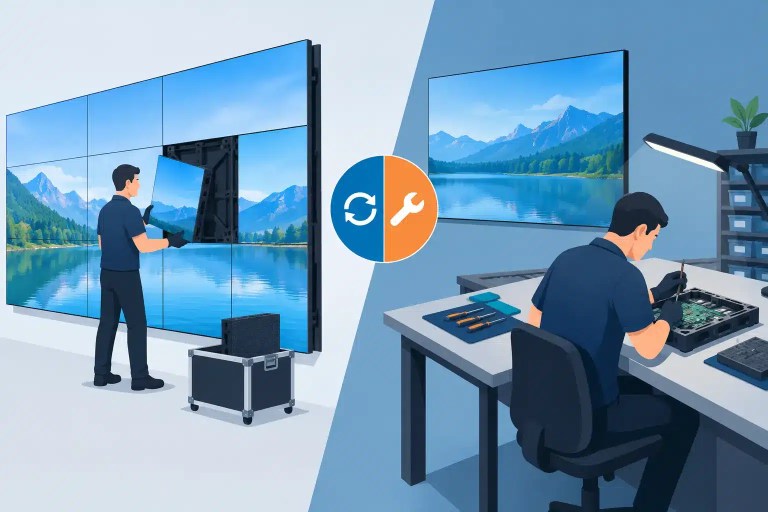
A single failed module can become a much larger problem when the wall is scheduled for a show, installed in a casino, or booked into rental inventory next week. The repair vs replace LED wall decision is rarely just about the price of one panel. It affects available spares, visual consistency, lead times, labor, client confidence, and the operational impact of another failure after the system goes back into service.
For professional AV operators, replacement is sometimes the correct answer. But it should not be the default response to dead pixels, color shifts, intermittent rows, damaged connectors, or an apparently failed module. Many faults that look like a bad panel begin at the component level and can be diagnosed, repaired, and tested without taking a matching module out of service permanently.
Repair vs Replace LED Wall: Start With the Actual Failure
One of the easiest ways to waste money is to replace equipment before confirming what failed. An LED wall symptom is not always an LED wall failure. A dark section may point to a module, but it can also originate with a receiving card, ribbon cable, power path, signal chain, mapping issue, processor setting, or damaged connector.
A proper diagnosis separates the symptom from the root cause. For example, a repeating vertical line may indicate a failed driver IC or PCB trace. A color problem limited to one area can be caused by a damaged LED package, an IC issue, or calibration mismatch. Intermittent failures may only appear after the module warms up, flexes under handling, or runs at normal brightness for an extended period.
That distinction matters because a replacement module may not solve an upstream signal or control issue. It can also introduce a new problem if its batch, calibration data, brightness, or color characteristics do not match the installed wall.
Before approving replacement, verify the fault through controlled testing. That includes inspecting the module and connectors, checking power and data paths, testing known-good components where appropriate, and evaluating the module under representative operating conditions. For a wall with recurring failures, the investigation should go further. Repeated module loss can signal handling damage, power instability, cabinet alignment stress, moisture exposure, improper previous repairs, or a processor and receiving-card issue rather than isolated bad luck.
When LED Wall Repair Is the Better Business Decision
Component-level repair can be a practical option when the module is otherwise serviceable and the failure is localized. This is particularly relevant for rental inventory, discontinued product lines, fine-pitch displays, custom installations, and walls where a like-for-like replacement is difficult to source.
Repair makes practical sense when a technician can identify and correct a specific failure, such as a damaged LED, failed driver IC, compromised PCB trace, loose connector, damaged pad, or power-related component. Precision soldering and microscope-level work can restore a module without sacrificing a matching spare. For operators managing dozens or hundreds of panels, preserving repairable inventory can help protect both capital budgets and deployment capacity.
Repair is also valuable when visual matching matters more than a simple power-on result. A module can illuminate and still be unsuitable for a client-facing wall if it shows brightness variation, color inconsistency, scan artifacts, or unstable behavior. The goal is not merely to get pixels lit. The goal is to return a panel that performs appropriately within the rest of the display.
There is an operational benefit as well. Replacement parts may be delayed, unavailable, or subject to minimum purchase quantities. Repair can keep viable equipment in circulation while procurement works through a longer-term replacement plan. That is especially useful when a venue or production company needs to protect upcoming commitments without making a rushed purchasing decision.
When Replacing the LED Wall Module Is the More Practical Choice
Not every panel should be repaired. Severe physical damage, widespread PCB delamination, extensive corrosion, repeated failures across multiple circuits, or structural damage can make replacement more practical than attempting a repair. The same applies when a module has been repaired repeatedly and continues to develop new faults under normal use.
Replacement may be appropriate when the repair cost approaches the cost of a verified, compatible module and the repaired unit would still require additional evaluation before returning to service. It may also be the better path when the system is near end of life and compatible spares are available now but unlikely to remain available later. In that case, buying strategic spares can be more valuable than repairing every marginal panel.
The important word is compatible. Professional LED modules are not interchangeable simply because they share a size, connector layout, or pixel pitch. Scan rate, driver IC configuration, HUB pinout, refresh behavior, mechanical fit, brightness, color characteristics, and calibration can all affect whether a replacement panel works properly in the wall.
A replacement module should be evaluated in the actual cabinet and tested against surrounding modules. If calibration is required, it should be completed before the display returns to a high-visibility environment. A mismatched module can be more disruptive to presentation quality than an obvious failed panel, particularly in broadcast, corporate, retail, hospitality, and live-event applications.
Compare the Full Cost, Not Just the Module Price
The purchase price of a new module is easy to see. The true cost of replacement is broader. It may include expedited shipping, procurement time, installation labor, calibration, configuration work, freight damage risk, and the cost of holding more spares. If the replacement does not resolve the actual root cause, the organization pays those costs and still has an unresolved wall.
Repair has its own variables. The fault must be diagnosable, the board must be repairable, and the repaired module must pass meaningful quality control. A low-cost repair that replaces a visible LED but ignores a weak pad, damaged trace, or failing IC may not provide meaningful long-term value.
For a practical decision, compare these factors:
- The confirmed failure mode and whether it is isolated or systemic.
- The availability, compatibility, and lead time of replacement modules.
- The repair cost relative to replacement and the expected remaining service life.
- The visual standard required for the application and the need for calibration.
- The cost of downtime, missed rental revenue, crew labor, and client exposure.
This approach helps prevent the common mistake of treating every bad-looking module as a disposable part. It also helps prevent the opposite mistake: investing repair time into equipment that may be approaching the end of its practical service life.
Why Documentation and QC Change the Decision
Professional LED repair should end with evidence, not assumptions. A module that looks correct on a bench can develop problems when installed in a cabinet, driven by the correct receiving card, or operated at higher brightness for a sustained period. Quality control should evaluate the repair across the conditions that matter to the display’s use.
That may include pixel and color verification, signal stability checks, inspection of soldered components and pads, functional testing with the appropriate configuration, and a final review for visible artifacts. For modules repaired after physical damage, QC should also consider how the repaired area behaves through normal handling, installation, and temperature changes.
Documentation gives operations teams a record of what failed, what was repaired, and what testing was completed. That information is useful when the same cabinet or product line returns with another issue. It helps distinguish an isolated component failure from a pattern that requires changes to handling, power distribution, preventive maintenance, or spare-part planning.
For large rental fleets and installed systems, this history becomes part of asset management. It supports better decisions about which modules to keep as serviceable spares, which cabinets need closer inspection, and when a product line is moving from routine repair into planned replacement.
A Practical Workflow for Professional LED Operators
When a wall fails, first isolate the issue without assuming the module is bad. Swap tested components only when doing so can narrow the fault safely and clearly. Record cabinet position, module serial information where available, visible symptoms, operating conditions, and whether the issue is constant or intermittent.
Next, separate urgent recovery from permanent corrective action. A spare module may be the right immediate move before doors open, while the removed module goes through full diagnosis afterward. That helps preserve uptime without turning a temporary swap into an unexamined disposal decision.
Finally, use the result to improve the fleet. If a repair reveals connector damage from handling, revise packing or load-out practices. If several modules show power-related stress, inspect the power path. If color inconsistency appears after replacing panels, review module matching and calibration procedures. A well-documented repair program can help reduce repeat problems rather than focusing only on the current failure.
With more than a decade of technical service experience supporting professional LED environments, 725Co. approaches failed LED equipment as a diagnostic problem first. Component-level repair, careful testing, and documented QC give operators a well-supported basis for deciding when replacement is expensive, delayed, or simply unnecessary.
The right decision is the one that gives the display a practical path back to professional service without creating an avoidable visual, technical, or inventory problem for the next show.

Jose de Jesus Martinez (Chuy) is the CEO of 725co. LED Repair Professionals, a trusted name in high-quality LED module repair and video wall services. With over 12 years of experience and certification as an electronic engineer, Chuy has built a reputation for excellence, partnering with industry leaders. Under his leadership, 725co is known for precision repairs, transparent service, and a commitment to protecting the long-term value of LED investments.