A failed LED panel rarely creates just one problem. It can hold up a load-in, reduce available rental inventory, compromise a client-facing installation, or leave a technical team making decisions under show-day pressure. Field repair versus depot repair is not simply a question of where the work happens. It is a decision about fault isolation, repair quality, logistics, available spares, and how much risk the system can carry before it returns to service.
For professional LED operators, the right answer depends on the failure itself. Some issues should be corrected at the venue or installation site. Others need a controlled bench environment, component-level diagnostics, and final testing that cannot be replicated beside an active wall.
What Field Repair Is Best Suited For
Field repair means diagnosing and correcting an issue where the LED system is installed, staged, or deployed. For a live event provider, that may mean a technician working during load-in or between show calls. For a permanent installation, it may mean servicing the display without removing large sections of the wall or taking the venue offline longer than necessary.
This approach is most effective when the likely cause is accessible and the repair can be validated within the operating system. Common examples include a loose or damaged data cable, a power distribution issue, an incorrectly seated module, a receiving card problem, incorrect configuration, mapping errors, or a panel that can be exchanged from available spare inventory.
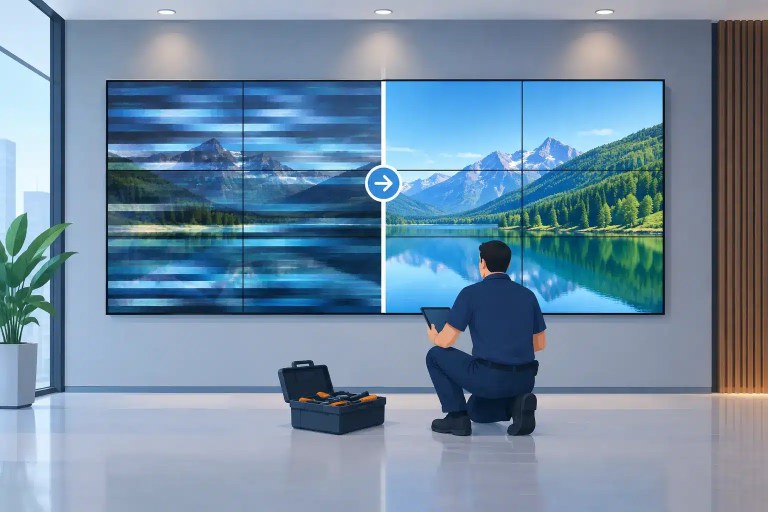
Field work is also valuable when the primary question is not yet “how do we repair this board?” but “where in the signal and power path is the fault occurring?” A qualified technician can observe the system under actual operating conditions, isolate a bad cabinet or module, check power and data flow, review controller behavior, and determine whether the fault follows the module, cable, port, receiving card, or processor output.
That context matters. An intermittent color shift may appear to be a module failure, yet the root cause could be a damaged Ethernet line, a marginal power supply, a configuration mismatch, or a processor issue affecting one output path. Replacing parts before identifying that distinction can consume time and create a misleading repair history.
The limits of repairing in the field
A field environment is not always a suitable electronics repair bench. Venue lighting, limited workspace, time pressure, dust, vibration, restricted access, and incomplete test equipment all affect what can be done responsibly. Precision soldering, driver IC replacement, trace repair, PCB-level fault isolation, and detailed inspection under magnification generally require controlled conditions.
There is also a difference between restoring an image for the next show and completing a durable repair. Swapping a known-good module may solve an immediate operational problem. Repairing the failed module so it can return to rental inventory requires a different process: diagnosis, component replacement where appropriate, inspection, burn-in or operational testing, and documented QC.
Field repair can be the fastest path to recovery, but it should not become a default for failures that need deeper analysis. Repeated onsite adjustments to the same panel or module often signal that the underlying fault has not been resolved.
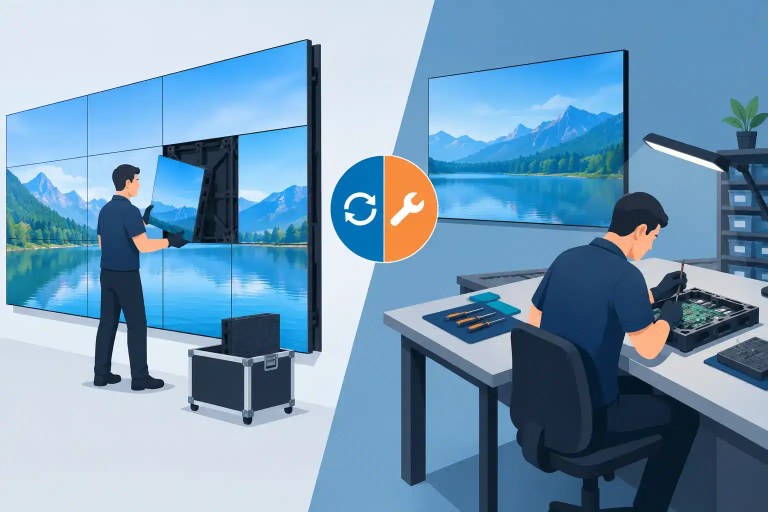
Field Repair Versus Depot Repair: The Core Difference
Depot repair moves the affected module, panel, receiving card, processor, or other component to a dedicated technical environment. The goal is not just to make the symptom disappear. It is to identify the failed component or fault condition, perform the appropriate repair, and verify performance before the item returns to service.
For LED modules, depot work can include dead pixel repair, driver IC replacement, PCB trace repair, connector inspection, damaged pad restoration, LED replacement, row or column fault analysis, and correction of color or output irregularities. For control equipment, it may involve processor and controller troubleshooting, port testing, power-path checks, firmware review where relevant, and verification against known-good equipment.
The practical advantage is repeatability. A depot technician can use stable power, controlled test sources, magnification, precision soldering tools, measurement equipment, and known-good modules or cards for comparison. That makes it easier to separate a true module-level fault from a system-level issue and to confirm that a repair performs correctly after reassembly.
Depot repair is often the better choice when the failure is intermittent, physically damaged, previously misdiagnosed, or recurring. It is also appropriate when replacement inventory is costly, discontinued, delayed, or not operationally practical. A professionally repaired module can extend the useful life of an existing display system, provided the repair is compatible with the module’s performance requirements and is tested before deployment.
How to Choose the Right Service Model
The decision should begin with operational urgency. If a wall must be functional for a show, presentation, gaming floor, or public-facing environment within hours, onsite diagnosis and a module swap may be the correct first move. The objective is to stabilize the system and protect the event or operation.
Once the immediate issue is contained, the removed module or panel can be sent for depot evaluation. This two-stage approach is common in professional AV because it separates emergency recovery from detailed repair work. It also prevents a spare module from becoming a permanent substitute while the failed asset sits unexamined.
If the issue affects multiple cabinets, a processor output, a receiving-card group, or a broad section of the wall, field diagnosis becomes more important before shipping components. Sending modules to a depot will not resolve a signal-routing problem, an incorrect configuration, a failing power distribution path, or a processor setting that affects a whole region of the display.
Conversely, if the fault clearly follows one module across cabinets, depot repair is usually the more efficient next step. The same is true when visible defects include isolated dead pixels, stuck color channels, dim sections, scan-line issues, physical PCB damage, or behavior that persists after cables, ports, and cabinet positions have been ruled out.
Cost is more than the repair invoice
Comparing field and depot service only by hourly labor or shipping cost can lead to the wrong decision. The actual cost includes downtime, travel, access restrictions, overtime, lost rental availability, replacement-module expense, repeat failures, and the risk of deploying an unreliable asset on the next job.
Field service can reduce immediate downtime, particularly when a technician can isolate the issue quickly and the operation has suitable spares. Depot service can reduce the longer-term cost of repeatedly replacing modules that are repairable at the component level. Neither model is automatically less expensive. The lower-cost option is the one that resolves the correct fault with an appropriate level of verification.
For rental and staging companies, repairable inventory deserves special attention. A module taken out of service after a show may not be a write-off. But it should not return to the shelf after a visual check alone. Documented evaluation helps distinguish a repaired, tested asset from a module that may fail again during the next deployment.
What Good Depot Repair Looks Like
A credible depot process starts with intake information. The technician should know the display brand and model, pixel pitch, symptom, cabinet location, failure history, prior repair attempts, and whether the issue follows the module or stays with the cabinet. Photos and short videos can be useful, especially for intermittent behavior or color-related defects.
The repair process should then match the fault. A dead LED is not the same as a failed driver IC. A row fault is not necessarily a cable issue. A damaged connector can create symptoms that resemble a processing problem. Careful diagnostics avoid replacing components based on appearance alone.
After repair, the item should be tested for the symptom that brought it in, not merely powered up. Depending on the component, that may include image testing, color checks, scan behavior, signal stability, connector integrity, and comparison with known-good equipment. Documentation matters because it gives the client a usable service record and supports better decisions when similar faults appear elsewhere in the inventory.
For organizations managing high-value LED assets, a technical partner should also communicate clearly about repairability. Some damage can be repaired reliably. Some modules are too compromised, no longer supported, or not economically sensible to rebuild. Straight answers protect the client from spending money on work that does not serve the system’s operational needs.
Build Repair Planning Around Your Spare Strategy
The strongest repair programs do not treat every fault as an emergency. They maintain a workable spare ratio, track recurring failures by product line and cabinet position, label removed modules clearly, and separate field-ready spares from modules awaiting evaluation.
This is where a specialized repair partner such as 725Co. can support the larger operation: not by replacing a client’s technical team, but by handling the component-level diagnosis, precision repair, and documented QC that are difficult to perform under field conditions. That gives internal teams and field technicians better information about what failed, what was repaired, and whether a recurring pattern needs attention.
When a panel fails before a show, recover the wall first. When the pressure is off, make sure the removed asset receives the level of diagnosis it needs. That discipline turns a temporary workaround into a more reliable inventory decision.

Jose de Jesus Martinez (Chuy) is the CEO of 725co. LED Repair Professionals, a trusted name in high-quality LED module repair and video wall services. With over 12 years of experience and certification as an electronic engineer, Chuy has built a reputation for excellence, partnering with industry leaders. Under his leadership, 725co is known for precision repairs, transparent service, and a commitment to protecting the long-term value of LED investments.