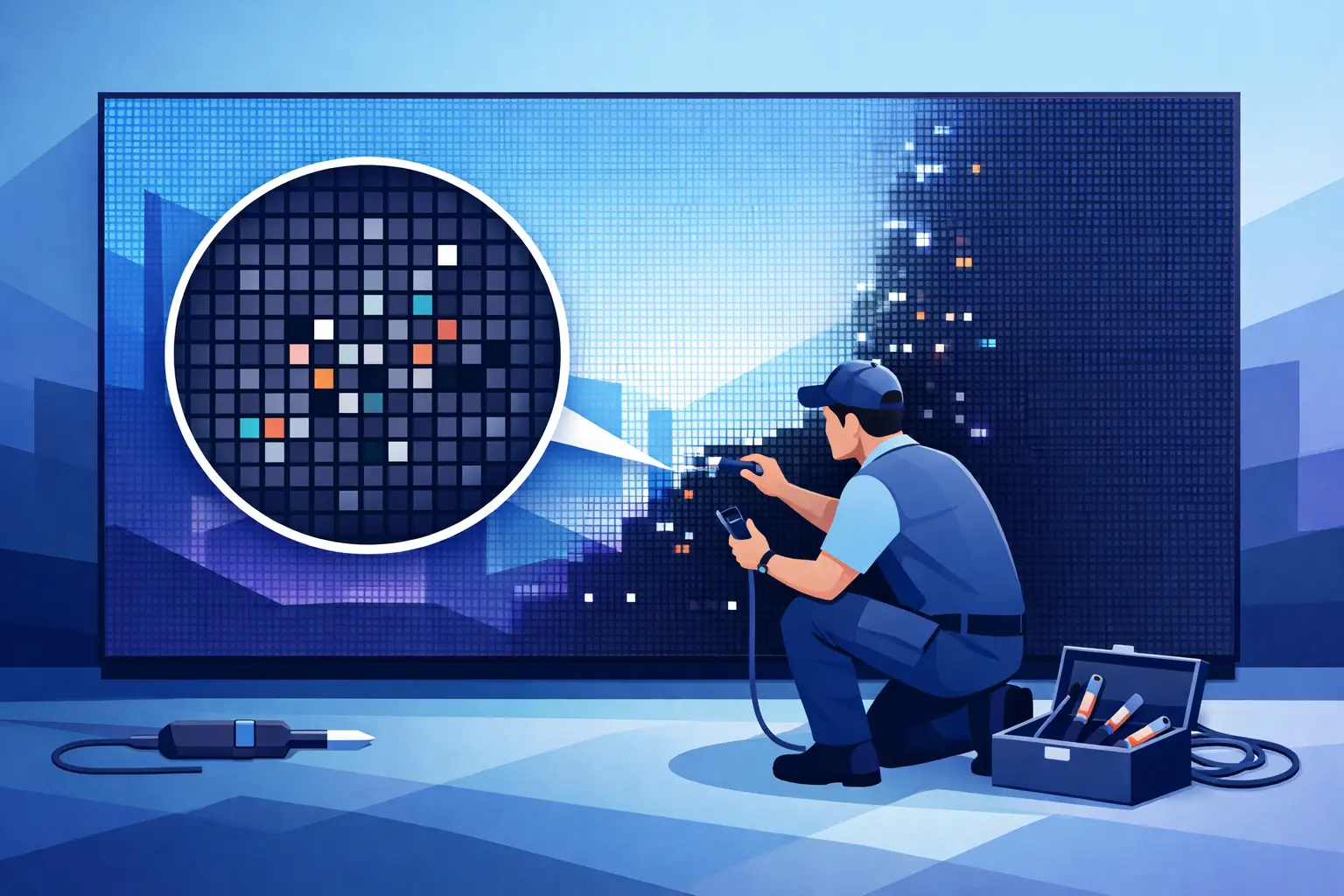
A pixel failure on a professional LED wall rarely shows up at a convenient time. It appears during prep, in the middle of a rental cycle, or right before content goes live on a client-facing display. When that happens, one of the first questions is simple: can pixel damage be fixed? In many cases, yes — but the right answer depends on what actually failed, how widespread the damage is, and whether the issue is isolated to the LED package, the driving circuitry, or the module itself.
That distinction matters more than most teams expect. A bad-looking pixel is not always a bad pixel. What appears to be a single dead, stuck, dim, or color-shifted point can be caused by a failed LED, a damaged pad, a bad solder joint, a driver IC problem, PCB trace damage, or an issue upstream in data or power distribution. If the diagnosis is wrong, the repair may address the visible symptom without resolving the actual cause.
Can pixel damage be fixed in professional LED displays?
For commercial LED displays, pixel damage can often be addressed through component-level repair. That may involve replacing the failed LED itself, repairing pads or traces on the PCB, correcting solder defects, replacing a driver IC, or addressing module-level electrical faults that are presenting as pixel loss. In a professional environment, the goal is not just to make the pixel light up again. The goal is to restore appropriate electrical and visual performance and evaluate the module under representative operating conditions.
This is why professional repair is different from a simple visual touch-up. A module may power up and appear functional on a bench for a few minutes, then develop problems once it heats up, receives full video load, or returns to service in rental inventory. Proper repair should account for thermal behavior, signal integrity, component condition, and final QC.
There are also cases where pixel damage is technically repairable but not practically worth repairing. If a module has widespread physical impact damage, multiple layers of poor previous repair work, lifted pads across a dense area, or recurring failures tied to deeper PCB degradation, replacement may be the better decision. A qualified repair partner should be able to explain that distinction clearly instead of forcing every module into a repair attempt.
What actually causes pixel failure?
In the field, pixel damage usually falls into a few categories. The most obvious is direct LED failure. A red, green, or blue element may go dark, stay stuck on, or drift in brightness. That kind of problem is often repairable if the surrounding board is still in good condition.
The second category is solder and interconnect failure. Rental inventory, touring use, vibration, repeated handling, and impact events can create fractures or intermittent connections that look like pixel failure. Sometimes the LED is fine, but the connection feeding it is not.
Then there is driver-related failure. A bad driver IC can affect one pixel, a small cluster, a line, or a repeating pattern. These are cases that can be misdiagnosed if the visible symptom is treated as an LED-only problem. Teams may replace LEDs, see no improvement, and lose time chasing the wrong fault. If the problem is in the drive path, replacing the LED package does nothing.
Physical board damage is another factor. A module that took a corner hit, compression damage, or improper handling may have broken traces, damaged pads, or compromised layers. Those failures may still be repairable, but the work becomes more precise and the repair decision depends heavily on how much of the board structure remains intact.
Environmental stress also plays a role. Heat, moisture exposure, contamination, and power irregularities can all contribute to pixel instability or failure. In those cases, the failed pixel may be the visible symptom rather than the root problem.
How to tell whether pixel damage can be fixed
The first step is not repair. It is diagnosis. Before any component is replaced, the failure needs to be isolated correctly. On a professional LED wall, that means looking beyond the visible symptom and determining whether the issue follows the module, the scan path, the receiving system, or a specific circuit area on the board.
A true pixel-level repair candidate usually has localized failure with otherwise stable module behavior. If the rest of the module is operating normally, power is stable, signal flow is intact, and the fault maps to a specific LED or small electrical area, repair can be a practical option.
If the module shows broader instability — flicker, repeating line issues, grouped color anomalies, intermittent dropout, or behavior that changes with temperature or pressure — the problem may involve ICs, board-level damage, or upstream control. That still may be repairable, but it is no longer a simple pixel replacement.
Previous repair history matters too. Modules that have already been reworked multiple times may arrive with damaged pads, poor solder quality, mismatched LEDs, or heat-stressed board material. Those conditions do not automatically make repair impossible, but they do change the technical assessment. There is also a point where replacement may become the more practical choice.
What a proper pixel repair should include
A professional pixel repair is a controlled electronics repair process, not just a swap of tiny parts under magnification. The failed area should be inspected for LED condition, pad integrity, trace continuity, driver behavior, and signs of collateral damage. If a component is replaced, it should be done with clean soldering technique, correct alignment, and attention to surrounding parts.
Matching matters. On LED displays, a repaired pixel that lights but does not visually match can still be a problem, especially on premium indoor displays, close-view environments, broadcast sets, retail applications, and corporate installs. Brightness, color balance, and consistency all affect whether the repair is appropriate for the intended application.
QC matters just as much. A repaired module should be tested under representative operating conditions, not just powered long enough to confirm basic function. That includes checking output behavior, confirming no adjacent damage was introduced, and documenting how the module performed after repair. For rental houses and AV operators, documentation is part of inventory control and service accountability.
This is where experienced component-level repair has real value. Professional LED systems require attention to electrical behavior, visual matching, component selection, and final testing. That becomes especially important when replacement inventory is limited or lead times make new modules difficult to source.
When replacement makes more sense
Not every bad pixel should be repaired. If damage is extensive enough that multiple systems on the module are compromised, repair may become less practical than replacement. The same applies when module condition is poor across a larger batch, especially if there are signs of aging, water exposure, repeated impact, or inconsistent prior work.
Replacement may also be the better move if the display is in a highly visible permanent installation where visual uniformity carries more weight than preserving the original module. In other situations, especially with rental inventory or discontinued product lines, repair may provide a practical way to keep viable systems in service.
The decision usually comes down to three variables: the true failure mode, the value and condition of the asset, and the operational cost of downtime. A one-pixel problem on a current-production module is a different decision than recurring pixel failures across legacy inventory that is difficult to replace. There is no one-size-fits-all answer.
Why pixel problems get worse after bad repair attempts
One way a localized pixel issue can become a larger module problem is through improper handling or rework. Excessive heat, incorrect tools, misaligned components, and careless soldering can damage pads, shift nearby LEDs, weaken traces, or create intermittent faults that were not present originally. What started as a localized repair can become a board-level recovery job.
That is why professional clients may benefit from having questionable modules evaluated before repeated repair attempts create additional damage. Preserving as much of the original PCB condition as possible can give the repair team a clearer technical starting point.
For companies managing large LED inventories, this has a broader impact. One avoidable repair issue does not just affect a single module. It can create shortages in ready-to-rent inventory, delay show prep, complicate color matching across walls, and increase pressure on teams already working against a deadline.
A failed pixel does not always mean a panel is finished, and it does not automatically mean replacement is the best move. In many professional LED systems, pixel damage can be repaired when the actual cause is identified and the module remains a practical repair candidate. If your display supports revenue, live events, or high-visibility presentation, the more useful question is not simply whether the pixel can light again. It is whether the module has been properly diagnosed, repaired, tested, and documented before returning to service.

Jose de Jesus Martinez (Chuy) is the CEO of 725co. LED Repair Professionals, a trusted name in high-quality LED module repair and video wall services. With over 12 years of experience and certification as an electronic engineer, Chuy has built a reputation for excellence, partnering with industry leaders. Under his leadership, 725co is known for precision repairs, transparent service, and a commitment to protecting the long-term value of LED investments.