
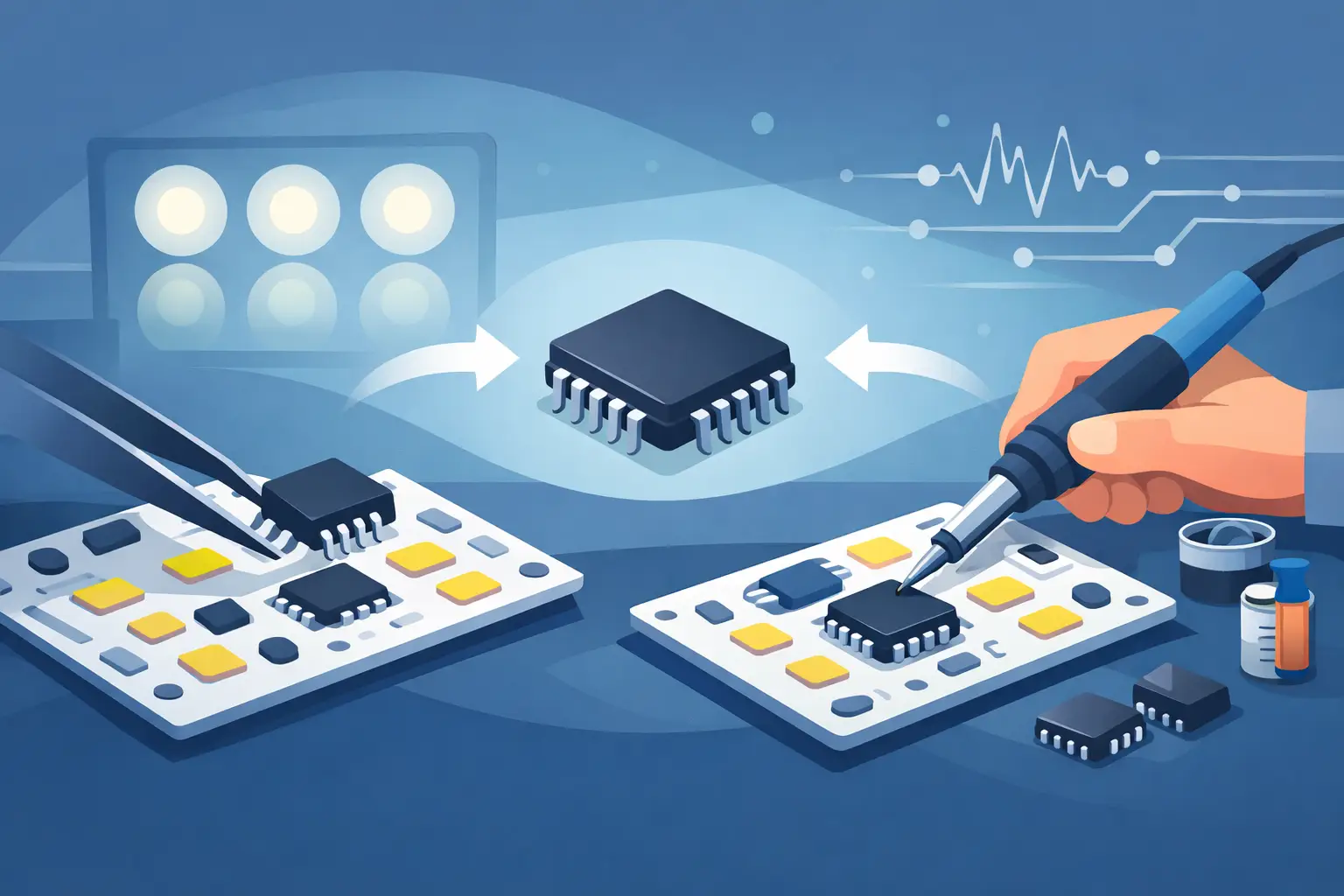
A module can look like it has a simple pixel failure while the actual problem sits inside one driver IC. For professional operators, IC replacement on LED modules can be the right repair when it restores a serviceable asset without waiting on replacement stock or writing off an otherwise healthy panel. It is not, however, a shortcut. The result depends on correctly identifying the failed component, protecting the PCB during rework, and evaluating how the module performs after repair.
For a rental house preparing inventory, a production team facing a show date, or an integrator supporting a high-visibility installation, the difference matters. A poor repair may light the pixels on the bench and still develop problems under scan load, heat, or extended operation. A proper component-level repair addresses the identified fault and verifies the module through appropriate testing before it returns to service.
What an IC Does on an LED Module
Most LED modules rely on driver ICs to control rows or columns of red, green, and blue LEDs. These devices receive display data and manage current to create the brightness, color, and grayscale performance expected from the module. When one driver IC fails, the visible result may be a single dead pixel, a repeated group of failed pixels, a horizontal or vertical line, incorrect color output, flickering, or a section that remains stuck on or off.
The pattern is useful, but it is not a diagnosis by itself. A repeated fault matching the output structure of a driver IC can point toward that IC or its surrounding circuit. The same visible line can also come from a damaged trace, poor solder joint, faulty LED package, power issue, connector problem, or receiving-card and configuration issue upstream.
That is why professional repair begins with the module and the signal path, not with an assumption that every pixel symptom requires an IC swap. Replacing a good IC wastes time and can introduce new damage to a board that may have been repairable by a less invasive method.
When IC Replacement on LED Modules Makes Sense
IC replacement is most practical when the rest of the module is in sound condition and the failure can be isolated with confidence. This is common when a module has a localized, repeatable output fault, stable input and power conditions, and no broader evidence of moisture damage, severe heat exposure, or PCB delamination.
It can also make sense when replacement modules are unavailable, have long lead times, or create a color and calibration mismatch with the installed display. For older cabinets and rental inventory, a new module is not always operationally equivalent to the one being removed. Even when the physical dimensions match, differences in LED binning, masks, scan configuration, brightness, or calibration can be visible on camera and to an audience.
There are situations where replacement is the better decision. A module with extensive corrosion, repeated failures across several ICs, damaged internal layers, lifted pads throughout the board, or a history of poor prior rework may not be a practical candidate for component-level repair. The repair decision should account for the condition of the asset, available spares, show schedule, cost of downtime, and whether the module can be appropriately evaluated after repair.
Diagnosis Must Come Before Soldering
A competent IC repair starts by confirming the fault under controlled test conditions. The module should be checked with known-good power, data, and configuration whenever possible. This helps separate a module-level defect from cabinet wiring, hub board, receiving card, processor, mapping, or firmware issues.
At the board level, the technician evaluates the failed pixel pattern, compares signal behavior with adjacent channels, inspects the area under magnification, and checks for physical damage around the suspected IC. Power rails, decoupling components, data paths, output channels, and solder joints all matter. A driver IC can appear failed when it is actually being supplied incorrectly or receiving compromised data.
Microscope-level inspection is especially valuable after impact damage or previous repair attempts. It can reveal cracked packages, bridged pins, cold joints, missing passives, damaged pads, and trace damage that is easy to miss with a visual check at normal distance. A module that was heated aggressively during an earlier repair may have weak pads or stressed LEDs around the work area. Those conditions change both the repair method and the evaluation required.
For complex systems, diagnosis should extend beyond the module. If multiple panels show the same abnormal behavior, the issue may be related to the processor, sending path, receiving-card configuration, cable path, or power distribution. Replacing ICs across multiple modules without verifying the system can turn a troubleshooting problem into an unnecessary repair bill.
The Difference Between Rework and a Quality-Focused Repair
Removing and replacing a fine-pitch driver IC requires controlled heat, correct tooling, and a process suited to the board and package. Excessive heat can discolor or damage nearby LEDs, shift components, weaken solder joints, warp the PCB, or lift pads. Insufficient heat or poor preparation can leave cold joints and inconsistent connections that may develop problems later in the field.
The replacement component must also be correct. Similar-looking ICs can have different current settings, channel counts, scan behavior, pinouts, or performance characteristics. Substituting an unverified part can create brightness differences, unstable grayscale, color imbalance, or compatibility problems that do not become obvious until the module is installed in a live wall.
After removal, pads and traces need to be assessed before the new component is installed. If the board has pad damage, the repair may require trace restoration or pad repair rather than simply placing another IC on compromised landings. This is where component-level experience matters. The goal is not to make the module display an image for a few minutes. The goal is to restore electrical integrity and evaluate the repaired area under conditions relevant to normal handling, vibration, heat, and extended runtime.
725Co. approaches this work as technical service for professional LED assets, not as a basic parts swap. With more than a decade of technical service experience supporting professional LED environments, the focus is on isolating the actual failure, performing precision rework, and documenting the results clients need to make operational decisions.
Why a Bench Test Is Not Enough
A repaired module should be tested using patterns that expose issues a basic image can hide. Solid red, green, blue, white, black, grayscale, and moving content can reveal dead outputs, stuck channels, low brightness, color imbalance, intermittent behavior, and scan artifacts. The module should also be observed for flicker and stability after it has been powered long enough to reach representative operating temperature.
Comparison with a known-good module is often useful, particularly for brightness and color consistency. A repair may be electrically successful but still be unsuitable if it creates a visible patch in a premium installation or camera-facing event wall. For fine-pitch displays, minor inconsistencies can be far more noticeable than they are on a coarse-pitch outdoor product.
Quality control should also include inspection of the repaired area under magnification. This helps confirm joint quality, verifies that no solder bridges or disturbed components remain, and provides a final check before the module returns to a cabinet. Documented QC gives operations teams a clearer record of what was found, what was repaired, and how the module performed after service.
Replacement Costs Are Only One Part of the Decision
Component-level repair can reduce avoidable replacement expense, but cost alone should not drive the decision. For a professional operator, the larger consideration is whether the repair supports uptime and presentation quality. A low-cost repair that returns as an intermittent fault during a corporate keynote, casino installation, broadcast, or arena event may create more operational expense than it saves.
Likewise, immediately replacing every failed module can create inventory pressure and lead-time problems, especially when the display model is discontinued or original modules are difficult to source. Repair can help preserve matching inventory, extend the useful life of installed systems, and keep more spares available for situations where replacement is genuinely necessary.
The practical approach is to repair modules that can be appropriately restored and tested, replace modules whose condition makes further repair impractical, and investigate system-level causes when the pattern suggests the module is not the source of the problem.
What to Send With a Failed Module
A repair partner can diagnose more efficiently when the module arrives with clear information about the failure. Include the module model or part number, display brand, pixel pitch, scan configuration if known, and photos or video of the symptom. Note whether the problem is constant, intermittent, heat-related, or triggered by movement. If the module came from a specific cabinet position, record that location and whether neighboring modules show similar behavior.
This information does not replace testing, but it helps narrow the path more quickly. It can also prevent a module-level repair from being used to mask a broader cabinet or controller issue.
When a display failure puts an event, venue, or client deliverable at risk, a useful next step is not guessing which part failed. Preserve the symptom, isolate the affected equipment, and have the module evaluated with the same level of technical care expected from the professional LED system it supports.

Jose de Jesus Martinez (Chuy) is the CEO of 725co. LED Repair Professionals, a trusted name in high-quality LED module repair and video wall services. With over 12 years of experience and certification as an electronic engineer, Chuy has built a reputation for excellence, partnering with industry leaders. Under his leadership, 725co is known for precision repairs, transparent service, and a commitment to protecting the long-term value of LED investments.


2 Responses