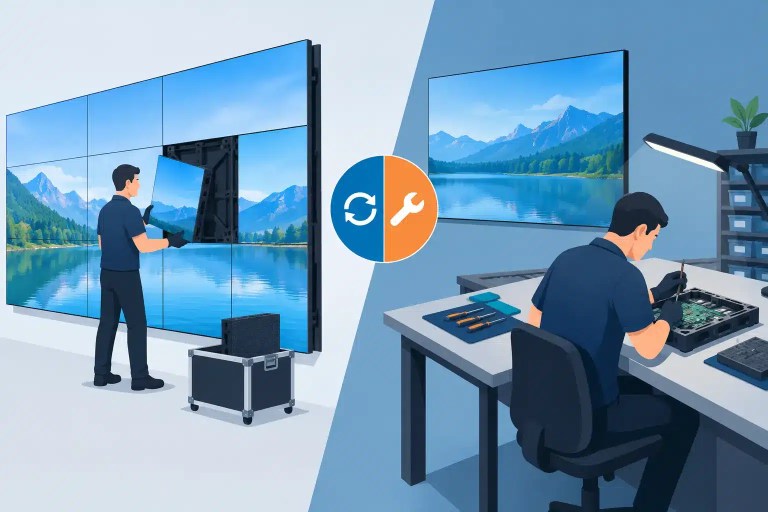
A video wall can fail in ways that look simple from the floor: a dead pixel cluster, an intermittent row, a color shift, a module that will not initialize, or a panel that drops during a show. The difference between specialist vs general electronics repair becomes clearer when that visible symptom has several possible causes and the next event, install deadline, or rental deployment is already on the calendar.
For professional LED operators, the decision is not simply about finding someone who can make a damaged module light up once. It is about determining what failed, how the repair performs under operating conditions, how it affects image consistency across the wall, and whether the equipment has been properly evaluated before returning to service. That requires a repair process that understands commercial LED systems and the technical variables associated with them.
What General Electronics Repair Can Do Well
A general electronics repair provider may be a reasonable option for straightforward, lower-complexity issues. They can often identify obvious physical damage, replace accessible connectors, repair basic power faults, or swap a known-bad assembly when replacement parts are available. For equipment where exact visual performance, calibration, and inventory consistency are not major concerns, that level of service may be sufficient.
The main difference is specialization. General electronics repair may cover many device categories, while professional LED displays introduce a specific set of variables. A single module is part of a larger system involving LEDs, driver ICs, PCB traces, scan behavior, receiving cards, firmware, processor settings, power distribution, module mapping, and calibration data.
A repair that appears successful on a bench can still develop issues in a deployed wall. The module may show a different color temperature, exhibit brightness variation at low gray levels, develop problems after temperature changes, or behave inconsistently at the required refresh rate. In rental inventory, an unresolved module can become a recurring prep-room issue that follows the same panel from job to job.
Specialist vs General Electronics Repair for LED Walls
The practical distinction is diagnosis depth. A specialist begins by separating the symptom from the root cause. A black area may be a failed LED, but it may also point to a damaged driver IC, a broken trace, a connector issue, a power fault, a receiving-card configuration problem, or a problem upstream in the signal chain. Replacing the visible part without resolving the underlying fault can allow the problem to return.
Specialized LED repair also accounts for the fact that a display is judged as a complete image, not as an isolated circuit board. A module needs to work electrically, but it also needs to match surrounding modules closely enough for the intended application. That means evaluating pixel behavior, color, brightness, uniformity, scan performance, and stability after the repair.
At 725Co., component-level repair is used where it makes operational and financial sense. That can include replacing failed LEDs and driver ICs, rebuilding damaged PCB areas, correcting solder defects, addressing connector damage, and troubleshooting module-level faults that do not justify replacing an entire assembly. The goal is not to force a repair in every situation. It is to give the operator a technically sound assessment of whether repair, replacement, or further system troubleshooting is the appropriate next step.
The Cost of Treating a Professional Module Like a Standard Replacement Part
A professional LED module is not always interchangeable simply because another board has the same physical dimensions. Binning, batch variation, calibration, revision differences, and availability can affect the final result. Older or discontinued product lines can make the decision even more difficult, especially when matching spare inventory is limited.
Unnecessary module replacement can also create a secondary problem: the removed module may have been repairable. If the real fault was a single IC, failed pixel group, trace issue, or connector-related defect, discarding the module can increase replacement spending without addressing the larger technical picture.
This does not mean every module should be repaired. Severe PCB damage, widespread degradation, water exposure, unavailable components, or a module with multiple recurring faults may make replacement the better choice. A specialized repair partner should be able to explain that distinction clearly. The useful answer is not always “repair it.” It is an explanation of what failed, the condition of the asset, and the practical options available for returning the system to service.
Why Diagnosis Matters Before Any Soldering Begins
Precision soldering is valuable only when it follows proper fault isolation. In professional LED systems, an incorrect diagnosis can waste more time than the original failure. A technician may replace LEDs for a dim area when the real issue is a driver channel. They may repair a module that is actually responding to a processor configuration problem. They may attribute intermittent behavior to a panel when a cable, power supply, receiving card, or data path is at fault.
A specialist repair process examines the module and the surrounding system context. That can involve microscope-level inspection, continuity testing, component testing, signal-path evaluation, and comparison against known-good behavior. The findings should guide the work rather than assumptions based on a photo or a single symptom.
This matters especially under production pressure. When a screen is needed for a live event, casino floor, corporate presentation, or high-visibility retail installation, teams benefit from a clear explanation of the failure, repairability, expected turnaround, and what will be tested before equipment is returned.
Quality Control Is Part of the Repair
For a professional AV operation, a repair should involve more than confirming that power comes on. The module or system should be tested against conditions relevant to its intended use. That includes verifying pixel operation, checking for visual artifacts, evaluating behavior over time, and documenting the completed work.
Documented quality control creates accountability. It helps a rental manager track what was repaired before the next deployment. It gives an integrator useful information for maintenance records. It helps technical teams distinguish a new issue from a previously addressed one. It can also reduce the chance that an unresolved defect returns to the field without being identified during testing.
The appropriate QC process varies by product and fault type. A single pixel repair and a damaged PCB reconstruction do not require exactly the same evaluation. But both benefit from the same discipline: confirm the fault, verify the repair, evaluate the result, and record the outcome.
When a General Provider May Still Make Sense
There are cases where a general electronics provider may be appropriate. If a known, easily sourced power component needs replacement, if the equipment has straightforward repair requirements, or if a simple external connection has been confirmed as the fault, a broader repair provider may be a practical option.
The calculation changes when failure affects show readiness, rental utilization, installation acceptance, or a client-facing environment. It also changes when the display issue is intermittent, visually sensitive, recurring, or difficult to isolate. In those situations, repeat work, downtime, replacement purchases, and unresolved inventory can become more significant than the initial repair price.
Choosing the Right Repair Partner
Ask practical questions before handing over a module or panel. Can the provider diagnose at the component level? Do they understand LED driver ICs, PCB faults, receiving-card behavior, and processor-related issues? Can they explain when repair may not be advisable? What testing occurs after the work is done, and what documentation will your team receive?
Experience with professional LED brands and deployment environments also matters. A repair partner should understand that modules used in rental and installed systems may experience repeated transport, setup, teardown, heat, long operating hours, and close visual scrutiny. The standard is not merely whether the module powers up on the bench. The standard is whether its performance has been appropriately evaluated before it returns to a wall.
When an LED failure puts a deadline at risk, a better repair decision starts with a precise diagnosis rather than the fastest-looking fix. Treat the damaged module as part of a larger visual system, and choose a process that supports uptime, inventory value, and the presentation quality your clients expect.

Jose de Jesus Martinez (Chuy) is the CEO of 725co. LED Repair Professionals, a trusted name in high-quality LED module repair and video wall services. With over 12 years of experience and certification as an electronic engineer, Chuy has built a reputation for excellence, partnering with industry leaders. Under his leadership, 725co is known for precision repairs, transparent service, and a commitment to protecting the long-term value of LED investments.