When a wall comes back from a show with dead pixels, intermittent rows, color shift, or a processor issue, the clock starts immediately. For professional teams, fast turnaround LED repair is not about rushing a box through a bench. It is about restoring usable inventory, protecting show schedules, and avoiding a replacement decision that may cost far more than the repair itself.
That distinction matters because speed by itself can create a second problem. A module that powers on after a quick touch-up is not the same as a module that has been properly diagnosed, repaired at the component level, tested, and documented. In live production, rental inventory, and permanent installations, unresolved repair issues often appear at the worst time — on-site, under load, and in front of a client.
What fast turnaround LED repair actually means
In professional AV, fast turnaround means the repair process is designed to reduce downtime without skipping the technical work needed for a quality-focused result. That starts with diagnosis. A panel may present as a pixel issue, but the real fault could sit in the driver IC, a damaged PCB trace, a bad connector, a receiving card problem, or a processor setting that was never corrected in the first place.
Teams that manage large LED inventories already know this firsthand. The same visible symptom can come from several different failure points. If a repair provider treats every issue like a simple parts swap, turnaround may look quick at intake but become less useful when the same hardware returns with unresolved problems.
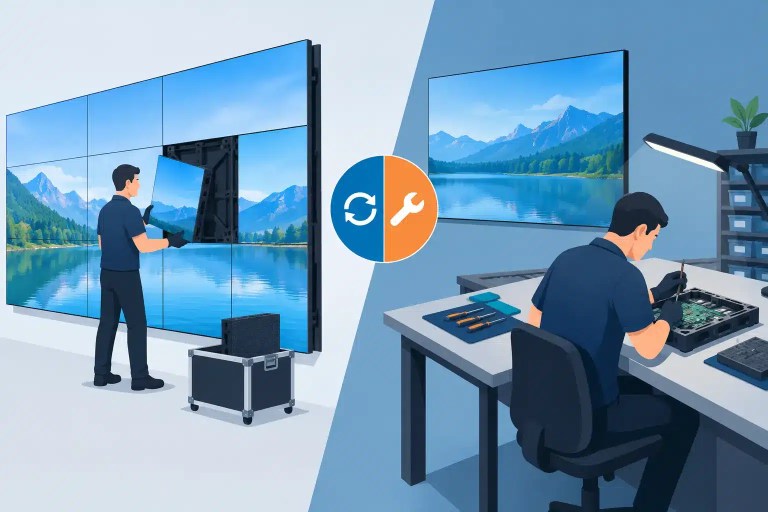
An effective fast-turnaround workflow focuses on triage, correct fault isolation, component-level repair where appropriate, and final QC that provides a documented basis for returning the unit to service. That is what reduces downtime in a meaningful way.
Expedited and rush turnaround may also be available depending on the repair scope, inventory volume, parts availability, and current service capacity. When the failure is clearly identified and the required components and bench capacity are available, some repairs may be prioritized for significantly shorter turnaround without removing the diagnostic and QC steps from the process.
Why speed alone is not enough
Rushed repair work can create additional risk. Modules may arrive after previous repair attempts with lifted pads, overheated components, missing solder mask, bridged joints, damaged LEDs, or replacement parts that did not match the board requirement. By the time the module reaches another bench, the visible symptom may have changed while the underlying issue remains unresolved.
For production companies and rental houses, that risk multiplies. One unstable module can hold up prep, consume labor, and reduce confidence in the inventory. For venues, casinos, retail, and corporate installations, recurring issues create another type of cost. The wall may still operate, but image quality can suffer, maintenance time increases, and the equipment requires additional attention.
Fast turnaround has the most value when speed is balanced with proper diagnosis, repair, and testing appropriate to the failure.
What makes fast turnaround LED repair possible
A shorter repair timeline usually comes from process discipline, not shortcuts. On professional LED systems, the work can move quickly when the failure is clearly identified, the required components are available, and the repair can be completed without compromising diagnosis or final QC.
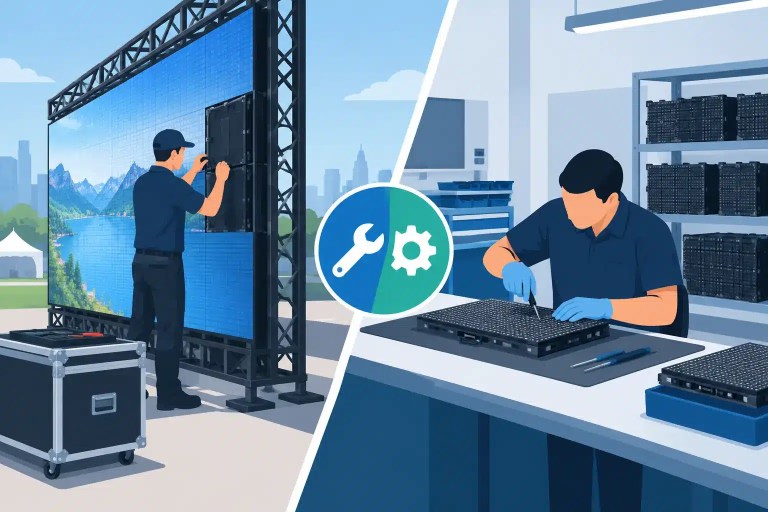
That includes microscope-level inspection, board-level diagnostics, precision soldering, driver IC replacement when needed, pixel-level repair, connector and trace repair, and controller or processor troubleshooting when the issue is not actually in the module. It also includes familiarity with major LED brands and the common failure patterns seen in rental panels, fixed-install tiles, sender and receiver systems, and image processing hardware.
Documentation matters here too. Intake notes, fault tracking, and post-repair QC keep the process moving because the work does not have to be re-diagnosed repeatedly. If a client sends a batch with mixed symptoms, organized evaluation helps separate repairable modules from units that need deeper board work or a different path altogether.
That is one reason a specialized LED repair provider may work more efficiently on these systems than a broader electronics repair operation. The tooling, workflow, and technical decisions are centered on professional LED display failures.
The trade-off clients should watch for
Not every job should be turned as quickly as possible.
If the failure is obvious and isolated, expedited repair may be realistic, including very short turnaround in certain situations. More complex cases involving water damage, repeated field failure, prior poor solder work, PCB damage, or inconsistent behavior across multiple modules may require additional diagnostic and testing time.
The appropriate timeline depends on what failed, how the hardware is used, parts availability, current bench capacity, inventory volume, and the operating requirements of the client.
For example, a rental house preparing for an event may prioritize getting a defined number of modules back into service while the rest of the batch goes through deeper evaluation. A permanent installation operator may prefer a more comprehensive path when recurring issues have already required repeated service. Neither approach is automatically right or wrong. A capable repair partner should be clear about what can reasonably be prioritized, what needs additional time, and why.
Where fast repair creates the most value
The benefit is usually largest where downtime has operational consequences beyond the part itself. That includes live event inventory, high-visibility venue screens, hospitality and casino environments, retail displays, corporate communication walls, houses of worship, and education spaces where failures interrupt scheduled use.
In those settings, replacement is not always the most practical first move. Matching older inventory can be difficult. Lead times may not work with the schedule. New panels may require remapping, calibration, processing changes, or visual adjustments that create additional work.
Efficient repair gives operators another option. Instead of writing off hardware that may still have useful service life, they can recover usable assets, preserve inventory value, and make replacement decisions on a planned timeline instead of under immediate pressure.
What to ask before sending equipment in
If turnaround matters, the first question is not just how fast. Ask what the provider is actually doing to the hardware.
A repair partner should be able to explain whether they perform component-level diagnostics, what kinds of failures they routinely handle, how they evaluate the repair, and what documentation comes back with the unit. It is also reasonable to ask whether they regularly work with professional LED display systems and understand the configuration, calibration, and system-level variables that affect them.
For technical teams, ask about IC replacement capability, PCB repair standards, connector work, image processing support, receiver and controller troubleshooting, and final test procedures. For operations and purchasing teams, useful questions include: What was found? What was repaired? What testing was completed? Is expedited service available for this particular repair?
Those answers often tell you more than a generic promised number of days.
Why documented QC matters in a fast-turnaround process
QC is often where rushed work falls short. If a module only gets a visual check, intermittent faults can slip through. If the panel is not tested under appropriate conditions, color consistency, scan issues, communication faults, and unresolved repair problems may not appear until the hardware is back on-site.
Documented quality control creates accountability. It records that the repair was completed and evaluated. For B2B clients managing inventory across shows, venues, or multiple locations, that documentation also helps with internal tracking. It gives technicians, warehouse teams, and managers a clearer basis for understanding the condition of returned equipment.
This is especially important when the hardware is client-facing or scheduled for a high-visibility deployment. A repaired module is more useful when the team installing it has documented information about how it was evaluated.
Choosing a repair partner, not just a bench service
Professional LED operators need more than vague turnaround promises. They need a technical partner who understands what a failed panel can mean for labor, schedules, inventory, and presentation quality.
That means choosing a company with experience in LED module repair, processor and controller troubleshooting, precision soldering, and repeatable QC. It also means working with a team that can explain the difference between a repairable module and a unit that may be better replaced. Good repair support is not about saying yes to everything. It is about making a well-supported technical decision efficiently and backing it with evidence.
With more than a decade of technical service experience supporting professional LED environments, 725Co. has seen the same pattern repeatedly: an efficient repair path is not necessarily the one with the least bench work. It is the one that identifies the actual fault early, addresses it appropriately, and documents the results before the hardware returns to service.
When your LED system is down, speed matters. Expedited service can matter even more when a show date or deployment is approaching. The goal is to move as quickly as the repair reasonably allows while preserving the diagnosis, component-level workmanship, and final QC that support the decision to return the equipment to service.

Jose de Jesus Martinez (Chuy) is the CEO of 725co. LED Repair Professionals, a trusted name in high-quality LED module repair and video wall services. With over 12 years of experience and certification as an electronic engineer, Chuy has built a reputation for excellence, partnering with industry leaders. Under his leadership, 725co is known for precision repairs, transparent service, and a commitment to protecting the long-term value of LED investments.