A single failed LED module can be a minor service item or the first visible sign of a larger system problem. For an AV rental company preparing inventory, a venue facing a show date, or an integrator supporting a permanent installation, LED repair costs are not just about the price of one panel. They can include diagnosis, labor, shipping, matching, testing, downtime, and the operational impact of putting unresolved equipment back into service.
That is why a meaningful repair estimate starts with the failure itself, not a one-size-fits-all price assumption. Professional LED displays are assemblies of modules, PCBs, ICs, power and signal paths, receiving cards, cables, and processing equipment. The visible symptom matters, but the root cause helps determine whether repair is a practical investment or replacement is the better decision.
What Drives LED Repair Costs?
The first cost variable is the type of failure. A small cluster of dead pixels, a single color channel failure, or an intermittent connection may be repairable at the component level. In those cases, the work can involve replacing LEDs, driver ICs, connectors, damaged pads, or other board-level components under magnification. This is different from simply swapping a module, and it can help preserve valuable inventory when replacement panels are unavailable or no longer manufactured.
A module with physical damage, severe PCB damage, water intrusion, burned layers, or multiple recurring faults may require more labor than its remaining value justifies. The same is true when the condition of the equipment makes it difficult to return the display to an appropriate visual and operational standard. An experienced technical repair partner should be willing to say when replacement is the more responsible option.
Pixel pitch and module construction also affect cost. Fine-pitch indoor modules generally require more delicate handling, tighter color and brightness expectations, and more precise soldering than larger-pitch touring products. Curved modules, flexible displays, transparent products, and specialty cabinets can add complexity because access, mechanical alignment, and replacement-part availability are less straightforward.
The number of affected units matters, but volume does not always mean a simple multiplication of the per-module price. If ten modules show the same symptom, a technician may identify a shared failure pattern, process issue, or environmental cause. That can improve diagnostic efficiency. On the other hand, ten modules with different damage histories may each require individual evaluation.
Urgency is another real cost factor. A repair needed for routine inventory replenishment can follow a normal diagnostic and QC process. A repair needed before load-in, a corporate presentation, or a venue reopening may require priority handling, expedited logistics, and more coordination. Faster service can be valuable, but reducing diagnostic or QC steps simply to move faster can create additional problems later.
Repair, Replacement, or a Larger System Fix
The least expensive visible fix is not always the lowest-cost decision. Replacing a visibly bad module may restore the picture temporarily, yet leave the original issue untouched if the problem is caused by signal instability, a failing receiving card, power irregularities, calibration mismatch, moisture exposure, or handling damage.
This is especially common in rental inventory. A module that appears to have random pixel failures may have been damaged in transit, stressed by an improper cable connection, or affected by a prior repair that did not meet appropriate soldering and inspection standards. Replacing it without understanding the condition of adjacent modules or the cabinet can lead to repeat failures at the next job.
Replacement makes sense when an exact, compatible module is readily available and the repair would exceed its practical value. It may also be necessary when a module has sustained damage that compromises its structure or makes a reliable return to service impractical. The challenge is that replacement inventory is often not immediate. Product lines are discontinued, bins differ, calibration data changes, and a replacement module may not visually match older stock without proper configuration and adjustment.
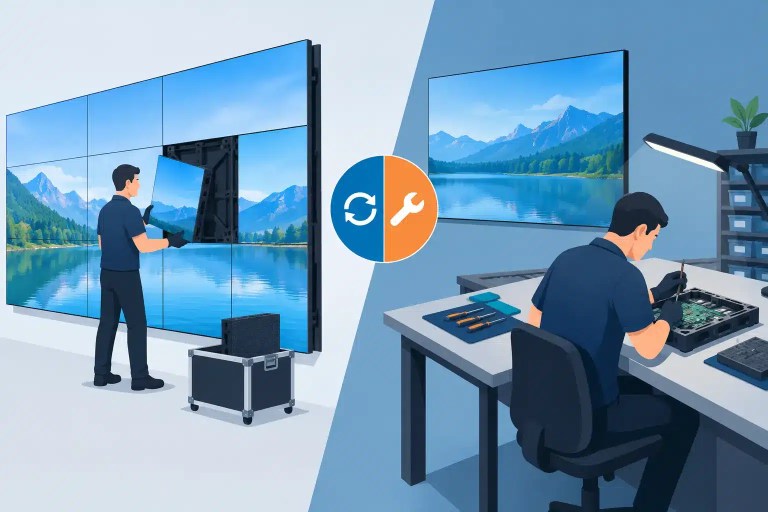
Component-level repair can be a practical option when the module is otherwise serviceable, replacement is delayed or expensive, and the failure can be isolated to repairable components. It is not a shortcut. Proper repair requires diagnosis, precision work, inspection, functional testing, and visual QC before the module returns to an LED wall.
The Cost of Diagnosis Is Usually Worth It
Professional LED systems rarely fail in neat, obvious ways. A black module may be a module problem, but it can also point to power, data flow, receiving card configuration, cabinet connections, or processor output. Color inconsistency can result from bad LEDs or ICs, but it may also involve calibration, mapping, signal settings, or incompatible replacement material.
A good diagnostic process helps prevent two expensive mistakes: repairing the wrong component and replacing equipment that could have been restored. It also gives purchasing and operations teams a clearer basis for approval. Instead of authorizing a vague repair, they can evaluate the affected equipment, probable cause, repair scope, expected result, and any limitations that may remain.
At 725Co., component-level diagnostics are used to help separate a repairable module fault from a cabinet, controller, processor, or signal-path issue. That distinction matters because a repaired module will not solve a failing processor, and a new processor will not restore a damaged PCB.
What a Professional Repair Quote Should Clarify
A useful quote should not reduce a complex LED failure to a single unexplained line item. It should clarify whether the estimate covers initial diagnosis, component-level work, parts, testing, and documented quality control. If the issue may involve equipment beyond the module, the quote or service discussion should identify that possibility early.
For larger batches, ask whether the provider will inspect for recurring patterns. If multiple modules came from the same wall, event, or shipment, the failure may not be isolated. Knowing that before redeployment can help protect a rental house from sending the same underlying issue back into the field.
It is also reasonable to ask how repaired modules are verified. Basic power-up testing is not enough for professional inventory. A repaired module should be checked for pixel function, color behavior, stability, scan performance where applicable, and visible defects that could appear under a camera or on a dark background. Final testing should reflect the way the display will actually be used.
Hidden Costs That Affect the Real Number
The repair invoice is only one part of the financial picture. Downtime can be more expensive than the repair itself when a display is tied to a live event, casino floor, retail campaign, or client-facing installation. A wall that is technically operational but visually inconsistent can also create costs through labor, client dissatisfaction, and last-minute equipment substitutions.
Shipping and packaging deserve attention as well. Modules that are poorly packed can arrive with new corner damage, cracked LEDs, bent connectors, or other handling-related issues. If a provider receives equipment with inadequate documentation, troubleshooting can take longer because the original symptom, cabinet position, and operational history are unknown.
For recurring service needs, keep a basic failure record with module model, serial or asset number, cabinet location, symptom, date, event history, and prior repair work. This is not administrative overhead for its own sake. It helps identify repeat patterns, isolate problem cabinets, and make better decisions about spares and replacement planning.
How to Control LED Repair Costs Without Cutting Corners
Effective cost control starts before a module fails. Maintain matched spare inventory where possible, use proper packing and handling procedures, inspect modules after high-risk deployments, and avoid deploying panels with known intermittent behavior. A module that only develops problems after several hours of operation should not be treated as a known-good spare without further evaluation.
When a fault appears, document it before swapping parts. Photograph the display, note whether the issue follows the module or stays with the cabinet position, and record processor and receiving-card conditions if they are relevant. That information can reduce diagnostic time and help prevent unnecessary replacements.
Avoid treating every pixel issue as a simple LED swap. A damaged LED may be the visible failure, but the underlying cause can be a driver IC, PCB trace, solder joint, or environmental problem. Replacing only the symptom can produce a short-lived result and add more cost when the module returns with the same failure.
The right question is not, “What is the cheapest way to make this panel light up?” It is, “What repair path gives this asset the most practical route back to professional service at a reasonable total cost?” For professional AV teams, that answer comes from accurate diagnosis, repair work matched to the actual failure, and QC that provides a clear, documented basis for returning the equipment to service.

Jose de Jesus Martinez (Chuy) is the CEO of 725co. LED Repair Professionals, a trusted name in high-quality LED module repair and video wall services. With over 12 years of experience and certification as an electronic engineer, Chuy has built a reputation for excellence, partnering with industry leaders. Under his leadership, 725co is known for precision repairs, transparent service, and a commitment to protecting the long-term value of LED investments.