A panel fails the week of a show, a venue wall starts showing dead pixels, or a rental module comes back with impact damage. The first question is usually simple: can LED panel be repaired? In many professional systems, yes — but the real answer depends on what failed, how the panel was built, and whether the diagnosis goes deeper than swapping obvious parts.
For commercial LED walls, replacement is not always the most practical move. Matching inventory can be difficult, lead times can create scheduling problems, and replacing a full panel for a repairable fault can consume budget without addressing the root cause. A more useful question is whether the panel can be restored through proper component-level repair and documented testing under representative operating conditions.
Can LED panel be repaired in professional systems?
In many cases, yes. Professional LED panels are built from assemblies and electronic components that may be serviceable depending on the product and extent of the damage. A failed panel may involve a bad LED, damaged driver IC, PCB trace issue, power distribution problem, connector failure, receiving card issue, or previous repair damage that introduced an additional fault.
That matters because many visible symptoms look the same from the front of the wall. A row out, color shift, intermittent flicker, dark section, or scattered dead pixels can come from very different causes. Replacing the wrong part may temporarily hide the issue or do nothing at all. In rental and event environments especially, that can lead to repeat service work and additional downtime when the panel goes back into service.
Repair is most practical when the base panel structure remains viable and the failure can be isolated to serviceable components. If the cabinet is severely twisted, the PCB is heavily fractured across multiple areas, or impact damage has compromised alignment and multiple electrical systems, replacement may be the better call. Good repair decisions are based on diagnosis, condition, and available options.
What kinds of LED panel failures are actually repairable?
A wide range of failures may be repairable when the work is performed at the appropriate level.
Dead pixels and partial pixel failure are often repairable through LED replacement or correction of the supporting circuit path. Color issues may point to a failed LED package, but they can also come from a driver IC or signal problem. Entire rows or columns dropping out often suggest a control or drive-path fault rather than random LED failure. Intermittent behavior may trace back to solder joints, damaged connectors, power instability, or prior handling damage.
There are also failures behind the panel that get blamed on the panel itself. Receiving card issues, hub board faults, power supply irregularities, or processor and controller problems can make a healthy module appear defective. That is one reason quick visual triage is not enough. If the visible symptom is treated as the root cause, the same equipment may return with the same complaint.
In professional environments, we also see repairable damage after previous service attempts. Lifted pads, overheated boards, mismatched LEDs, inconsistent soldering, and damaged traces can make the repair more complex when a module was worked on without the appropriate tools or microscope-level inspection. Those conditions can sometimes be corrected, but they require a more careful evaluation of the board before additional work is performed.
When repair makes more sense than replacement
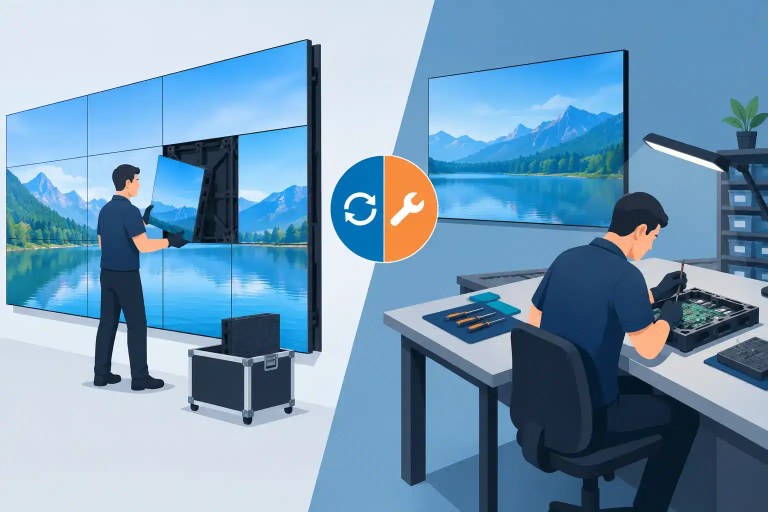
Replacement sounds straightforward on paper, but operations are rarely that simple. A rental house may need to preserve matching inventory. A venue may have an older product line where replacements are limited or no longer consistent in brightness and color. An integrator may be waiting on parts while a client still expects the wall to perform. In those situations, repair can be a practical asset-management decision.
Repair often makes sense when the issue is isolated, the panel is part of a larger installed or rental inventory, and avoiding unnecessary downtime or replacement is important. It is also valuable when the failure is recurring and the underlying cause has not yet been identified. Replacing modules without addressing a driver, signal, power, or workmanship problem can turn a technical issue into repeated purchasing and service activity.
The trade-off is that not every panel deserves repair time. If the repair cost approaches the value of a verified compatible replacement, or if the panel has suffered broad structural and electrical damage, replacement may be more practical. An experienced repair partner should be able to explain that distinction clearly.
Why professional diagnosis matters more than the symptom
The front of the LED wall only shows the result of a fault. It does not tell you where the failure started.
A panel with dead pixels may need LED replacement. Or the LEDs may be fine and the real issue may be the driver IC feeding them. A flickering section may be a board-level fault, but it could also be caused by inconsistent power or a signal path problem upstream. A black module may be defective, or it may simply not be receiving correct data. These distinctions affect cost, turnaround, and the appropriate repair path.
This is where component-level diagnostics matter. Instead of replacing assemblies until the image returns, the work starts by isolating the failed area and evaluating the actual cause. That can include tracing signal paths, checking IC behavior, inspecting solder integrity under magnification, evaluating PCB damage, confirming connector condition, and testing the repaired module under representative load.
For professional AV teams, this creates a stronger technical basis for determining whether the module should return to service, receive additional repair, or be replaced.
What a proper LED panel repair process should include
A professional repair process involves more than swapping a visible bad part. It should begin with fault verification and inspection rather than assumptions. The panel or module should be checked for impact damage, prior repair work, missing components, pad damage, contamination, and signs that the visible symptom may be secondary to another issue.
From there, component-level work should be performed with appropriate tools and controlled soldering practices. That may involve LED replacement, IC replacement, PCB trace restoration, connector repair, or correction of prior workmanship issues. Accuracy matters because poor rework can introduce intermittent faults that are more difficult to identify later.
Quality control is just as important as the repair itself. A repaired panel should be tested rather than simply powered on for a quick visual check. Professional QC should evaluate output behavior, color consistency, function across the repaired area, and operation under representative conditions. In high-visibility environments such as live events, rental inventory, casinos, corporate displays, and permanent installations, documentation also gives technical teams a record of what was found, repaired, and tested.
That process is one reason specialized providers exist. Professional LED walls involve component, configuration, calibration, and system-level considerations that differ from many other electronics applications. The operational consequences of failure can extend beyond the display itself to show schedules, client presentations, venue operations, and rental deployment.
Can LED panel be repaired after bad prior work?
Often, yes — but the repairability depends on how much additional damage occurred during the earlier attempt.
Poor soldering, excessive heat, lifted pads, incorrect components, and rough handling can turn a straightforward repair into a PCB-level recovery project. Some modules can still be evaluated and corrected through trace repair, pad restoration, and component replacement. Others may reach a point where the remaining board condition makes replacement more practical.
This is where technical judgment matters. Some panels are reasonable repair candidates because the damage is localized and the inventory value supports the work. Others should be removed from service because continued repair attempts may not be justified by their condition. An experienced repair partner should be able to distinguish between those situations and explain the available options.
725Co. is often asked to evaluate modules after previous repair attempts because the original failure or the full extent of the damage may still need to be identified. In those cases, the client needs more than another parts swap. They need a documented diagnostic and repair process that explains what is happening with the equipment.
The right question is not just whether it can be repaired
Most professional buyers, technicians, and operations teams already know some panels can be repaired. What they really need to know is whether a specific panel is a practical repair candidate, what work is required, and whether repair provides a better operational path than replacement.
That answer depends on the quality of diagnosis, the level of board and component work available, the condition of the panel, and the discipline of the QC process afterward. If those pieces are missing, repair can become expensive trial and error. When they are present, repair can help extend usable inventory life, reduce unnecessary replacement costs, and provide a documented basis for returning appropriate equipment to service.
When a panel fails, the fastest decision is not always the most useful one. A better decision is based on the actual fault, the condition of the asset, the available repair and replacement options, and testing that shows how the equipment performed after service.

Jose de Jesus Martinez (Chuy) is the CEO of 725co. LED Repair Professionals, a trusted name in high-quality LED module repair and video wall services. With over 12 years of experience and certification as an electronic engineer, Chuy has built a reputation for excellence, partnering with industry leaders. Under his leadership, 725co is known for precision repairs, transparent service, and a commitment to protecting the long-term value of LED investments.