A single failed module can turn a ready-to-deploy LED wall into a difficult inventory decision. The pressure is higher when the issue appears during prep, before load-in, or in a permanent installation where the screen cannot simply be taken offline. Effective commercial LED downtime reduction is not just about getting pixels to light again. It depends on identifying the real failure, repairing the right level of the system, and confirming the panel will perform reliably when it returns to service.
For AV rental houses, production teams, integrators, and venues, downtime has a wider cost than the repair itself. It can tie up technicians, reduce available rental inventory, create last-minute substitutions, and put presentation quality at risk. A damaged LED module is often repairable, but only if the diagnostic process goes beyond a quick visual check or a swap-and-hope approach.
Why LED Downtime Becomes an Operational Problem
Professional LED systems are assemblies of interdependent parts. A visible defect may originate in an LED package, driver IC, PCB trace, connector, power circuit, receiving card, calibration issue, processor setting, signal path, or mechanical damage. Replacing the module may restore the image in some cases, but it does not necessarily explain why the failure occurred.
That distinction matters most when the same issue returns. A panel with intermittent color behavior, repeated row failures, or unstable output may have a deeper component or signal-related cause. If only the symptom is addressed, the module can return to inventory with the original weakness still present.
For a rental operation, that can mean a panel passes a bench check but fails after transport, under extended runtime, or when installed alongside matching cabinets. For a venue, it can mean an intermittent fault becomes visible during a live program. The best repair decision is not always the fastest apparent decision. It is the one that restores dependable operation without creating another service event shortly afterward.
Commercial LED Downtime Reduction Starts With Diagnosis
Accurate diagnosis begins by separating the display symptom from the underlying failure. Dead pixels, dim sections, color shifts, scan-line issues, flickering, and black areas can look similar from a distance while requiring very different repairs.
A disciplined technical assessment considers the module in context. Technicians should evaluate physical condition, connectors, power and signal behavior, driver circuitry, LED packages, PCB integrity, and compatibility with the associated cabinet and control system. If the system-level issue is not ruled out, repairing a module alone may not resolve the problem.
This is particularly important with panels that have already been through internal repair attempts or field troubleshooting. Lifted pads, overheated components, damaged traces, incorrect replacement parts, and poor solder joints can complicate what began as a limited defect. Component-level work requires proper inspection equipment, controlled soldering methods, and an understanding of how the module operates electrically and visually.
At 725Co., this process is informed by 14 years of technical service supporting professional AV organizations, including companies such as Freeman, 4Wall, and PRG. The goal is practical: determine whether a repair is appropriate, identify what must be repaired, and document the result so the client can make an informed inventory decision.
Repair the Failure, Not Just the Symptom
A repair strategy should match the actual fault. A failed LED package may call for precision pixel replacement. A recurring color or row issue may point to a driver IC or PCB-level concern. Damage around a connector can require trace repair and stabilization rather than a simple connector replacement. Processor and controller problems require their own diagnostic path, including configuration, firmware, input behavior, mapping, and output verification.
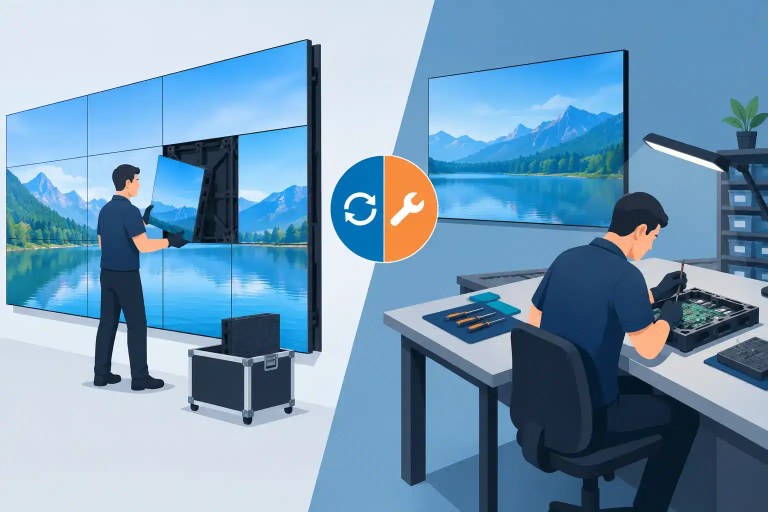
This is why component-level repair can be valuable for commercial LED assets. It can preserve a serviceable module or panel when full replacement is expensive, unavailable, mismatched, or operationally impractical. It also allows the technician to address specific defects without treating every failure as a reason to discard the assembly.
There are trade-offs. Not every module should be repaired. Severe physical damage, extensive corrosion, obsolete components, repeated failures across a batch, or poor prior repairs may make replacement the better operational choice. A technical partner should be clear about those conditions instead of treating repair as the answer in every case.
Build a Repair Process Around Return-to-Service Confidence
A module that powers on is not necessarily ready for a show, installation, or rental deployment. Return-to-service confidence comes from inspection, controlled repair, and final testing that reflects how the equipment will be used.
Microscope-level work helps technicians inspect solder joints, pads, traces, IC placement, and LED alignment before defects become visible at normal viewing distance. Precision soldering matters because excessive heat, poor alignment, or weak joints can create failures that appear only after handling or extended operation. On fine-pitch products, small workmanship errors can have an outsized effect on image quality and reliability.
Quality control should also account for visual performance. Repaired areas need to be checked for illumination, color consistency, pixel response, scan behavior, and surrounding image quality. Where applicable, the module should be verified within the compatible system environment rather than judged only as an isolated board.
Documentation gives repair work operational value. It creates a record of the defect, corrective work, testing outcome, and any recommendations for follow-up. For technical managers, that information helps track recurring issues across inventory. For purchasing and operations teams, it supports a clearer repair-versus-replace decision. For field crews, it reduces uncertainty about what has been serviced and why.
Separate Module Failures From Control-System Failures
Not every LED issue belongs to the module. A black cabinet, incorrect mapping, unstable output, unexpected color behavior, or intermittent image can originate upstream. Receiving cards, sending devices, processors, cabling, power distribution, configuration, or firmware can all affect what appears on screen.
The operational risk is obvious: a good module can be removed from service because the wrong part of the system was blamed. Conversely, replacing modules will not solve a processor or signal-path problem. Before approving a large replacement order or writing off multiple panels, verify the failure path.
This approach is especially useful when the defect moves, appears across several cabinets, changes with processor outputs, or occurs only in a particular configuration. Those patterns are diagnostic evidence. They should guide the service process rather than be treated as random behavior.
Reduce Future Downtime Before the Next Show
Repair is one part of downtime reduction. The other part is creating a more controlled approach to inventory health. High-use LED assets benefit from regular inspection after demanding deployments, particularly when panels have been exposed to transport stress, repeated assembly, moisture risk, impact damage, or rushed load-outs.
Teams do not need to overcomplicate this process. They do need a way to isolate suspect panels before they become critical spares. Tracking recurring defects by product line, cabinet position, module batch, or failure type can reveal patterns that are otherwise missed. A repeat driver IC failure, for example, deserves more attention than a one-time damaged pixel.
Maintaining known-good spare modules and cabinets remains sensible, but spares are not a substitute for repair discipline. If damaged units accumulate without diagnosis, an organization gradually loses usable inventory and visibility into what is actually failing. Repair records, final test results, and clearly identified service status help prevent that drift.
For permanent installations, planned service windows offer an opportunity to address minor defects before they become highly visible. For rental fleets, pre-deployment checks and post-return evaluations can protect utilization without requiring every unit to undergo unnecessary work. The right level of inspection depends on usage, product type, failure history, and the consequences of a visible issue.
Make Replacement a Decision, Not a Default
Replacement is sometimes necessary, especially when products are discontinued, damage is widespread, or repair would not provide a sensible service life. But immediate replacement is not the only responsible response to a failed commercial LED component.
When a technically sound component-level repair is available, it can keep matching inventory in circulation, avoid delays tied to sourcing, and reduce avoidable capital expense. This is particularly relevant for older but still valuable systems, where new modules may differ in batch characteristics, calibration behavior, or mechanical fit.
The key is to evaluate each failure with accurate information. What failed? Why did it fail? Can it be repaired to a dependable standard? Has the repaired unit been tested and documented? Those questions turn downtime from a reactive scramble into a managed technical process.
The next failed module does not have to become a last-minute replacement problem. With clear diagnostics, careful component-level repair, and documented QC, it can become a controlled decision that protects both display performance and the inventory your operation depends on.

Jose de Jesus Martinez (Chuy) is the CEO of 725co. LED Repair Professionals, a trusted name in high-quality LED module repair and video wall services. With over 12 years of experience and certification as an electronic engineer, Chuy has built a reputation for excellence, partnering with industry leaders. Under his leadership, 725co is known for precision repairs, transparent service, and a commitment to protecting the long-term value of LED investments.