A wall goes dark 30 minutes before doors, and suddenly the problem is not just a few bad pixels. It is client confidence, show flow, rental inventory availability, and whether your team has enough information to put that panel back into service. That is where led screen repair stops being a simple parts swap and becomes a technical service decision.
For professional AV companies, venues, integrators, and production teams, the real cost of failure is rarely limited to one module. A recurring color shift in a casino video wall, an intermittent panel in a church install, or a damaged rental tile that keeps circulating through inventory can create a chain of avoidable problems. Quality-focused repair can help extend usable asset life and provide a practical option when full replacement is not immediately necessary or available. Poorly resolved repairs can lead to additional downtime.
What led screen repair actually means in pro AV
In consumer electronics, repair may often involve replacing a larger assembly or complete device. Commercial LED systems require a more specialized diagnostic approach. Professional led screen repair is about identifying the actual failure point, whether that is a damaged LED, a failed driver IC, a PCB issue, a bad connector, a power problem, a calibration mismatch, or a controller-related fault presenting like a module defect.
That distinction matters because the visible symptom is not always the real cause. A row out, ghosting, flicker, color inconsistency, dead pixels, or a module that drops in and out can all point in different directions. Some are module-level failures. Some are cabinet-level. Some come from receiving cards, scan cards, power distribution, firmware, or processor configuration. If diagnosis is rushed, companies can end up replacing expensive parts that were not the actual source of the failure.
In professional environments, proper repair also includes verification. A panel that lights up on the bench is not automatically ready for rental stock, a permanent install, or a live event. The standard should go beyond partial function. The equipment should be evaluated and documented under conditions relevant to its intended use.
Why replacement is not always the smart answer
There are times when replacement is clearly the right call. If cabinets are structurally compromised, core components are no longer available, or panel age and failure rates are increasing across the system, repair may only delay a larger capital decision. But that is not every case, and replacement should ideally follow a clear understanding of the root issue.
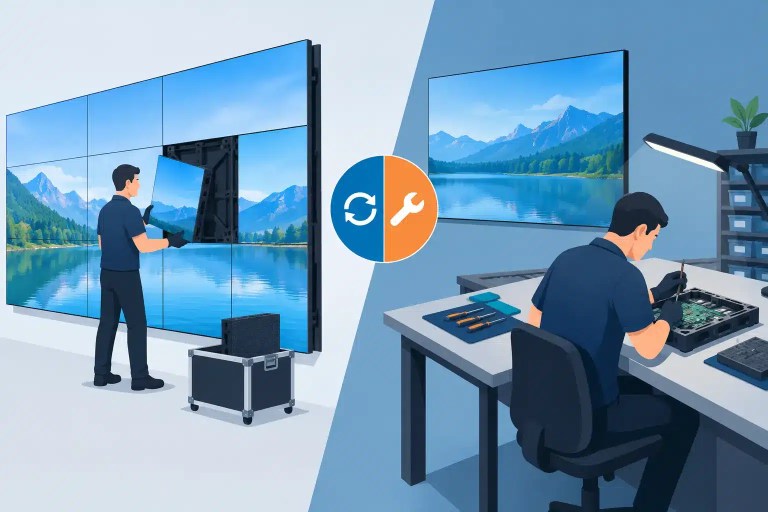
For rental houses and production companies, replacement can also create inventory mismatch. You may be dealing with discontinued product lines, binning differences, lead times, or calibration inconsistencies that make one new panel harder to integrate than expected. For fixed installs, replacement may trigger scheduling problems, access constraints, and budget approvals that do not align with the urgency of the failure.
A capable repair partner helps you evaluate that trade-off clearly. If a module can be restored through component-level work and documented testing, repair may provide a practical path back to service. If the failure pattern suggests broader instability, that information matters as well. The value is not just in fixing what is broken. It is in helping the client make a well-supported technical decision.
Common failures that get misdiagnosed
Many expensive mistakes in led screen repair start with symptom chasing. Teams see black pixels and assume LED replacement is the only issue. They swap modules to chase a color problem that may actually be controller-related. They blame the processor when the failure is on the board. They install replacement parts into cabinets with underlying connection damage and then see the fault return.
Intermittent behavior is especially easy to misread. A panel that passes briefly and then develops problems under normal thermal conditions may have solder fatigue, a marginal IC, or a PCB issue that only appears under load. Horizontal or vertical line failures can suggest scan or driver issues, but the exact cause depends on the module architecture and the rest of the signal path. Color shift can come from damaged LEDs, calibration mismatch, power irregularity, or prior repair work that introduced inconsistent components.
This is why professional repair work starts with diagnostics, not assumptions. In professional environments, speed matters, but technical accuracy is what gives the repair process value.
What a proper repair process should include
Professional clients should expect a repair process that is traceable. That means the incoming issue is documented, the fault is isolated, the actual repair is performed at the component level when appropriate, and the final result is tested before the equipment returns to service.
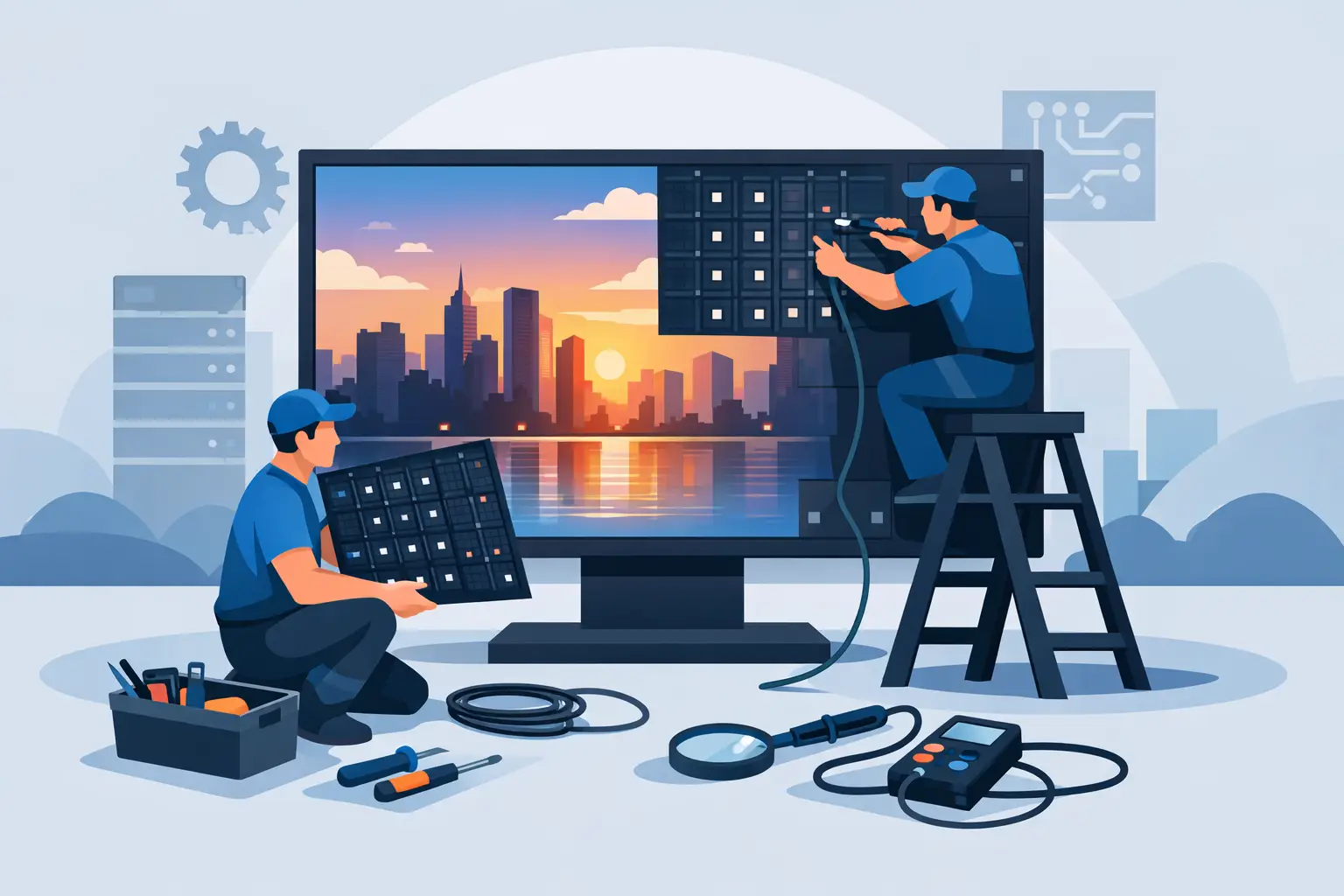
That process may include microscope inspection, board-level diagnostics, precision soldering, IC replacement, pixel repair, connector and pad evaluation, signal-path testing, and verification against known-good behavior. On processor and controller issues, it may also involve configuration review, firmware confirmation, and testing that separates display-side failures from control-side faults.
Quality control is an essential part of the process. In professional LED systems, a repaired module should not be considered complete simply because it powers on. It should be checked for visual consistency, image stability, electrical behavior, and performance under representative conditions. If a repair provider cannot explain how the work was evaluated, the client has less information for deciding whether that panel should return to inventory or the wall.
LED screen repair and the cost of previous repair work
Many B2B clients do not come in with a simple first-time failure. They may arrive after an internal repair attempt did not fully resolve the issue, after another service attempt replaced parts without correcting the cause, or after the panel returned looking functional but developed problems again under normal use.
Prior repair work can leave visible evidence. Lifted pads, overheated boards, misaligned components, poor solder joints, mismatched LEDs, and incomplete diagnostics can all make the next repair more complex. In some cases, the original fault is still present. In others, the earlier repair has added another issue.
That matters operationally because every additional repair cycle increases handling, shipping, labor, and scheduling pressure. It can also create uncertainty in inventory management. If a team is unsure about the condition of a repaired panel, that asset may require additional evaluation before being assigned to another deployment.
A disciplined repair process helps reduce that uncertainty by focusing on diagnosis, controlled component-level work, testing, and documentation rather than immediate output alone.
When component-level repair makes the most sense
Component-level led screen repair is especially valuable when replacement parts are delayed, cabinets remain important to an existing inventory, or a failed module represents a meaningful cost if written off too early. It is also a practical approach when the problem is isolated enough that replacing larger assemblies would be unnecessary.
For rental inventory, this can mean recovering additional usable life from modules that might otherwise be removed from circulation. For venues and permanent installs, it can mean restoring presentation quality without immediately entering a larger procurement cycle. For integrators supporting clients after handoff, it can reduce disruption and provide another technical option before replacement.
The decision still depends on condition, product age, and failure pattern. If the same product family is showing broad problems across many cabinets, repair may need to be considered alongside a larger maintenance or replacement strategy. But when the issue is specific and diagnosable, component-level work can be a practical path.
Choosing a repair partner for professional LED systems
The useful question is not simply who says they repair LED. A better question is who can diagnose at the board and component level, document the work, and explain how the equipment was evaluated before returning to service.
That means looking for evidence of technical experience, precision rework capability, familiarity with major LED platforms, and a repair workflow built around professional display systems. A provider should be able to speak clearly about IC replacement, PCB repair, controller troubleshooting, visual verification, and QC documentation.
It also helps to work with a partner who understands the operational context of the failure. A rental company has different pressure than a casino. A touring production has different urgency than a retail installation. A capable technical partner takes that context into account when discussing turnaround, repairability, testing, and replacement options.
For companies that depend on LED performance, repair is part of asset management and client delivery. That is why 725Co. focuses on identifying the problem beneath the visible symptom, using component-level methods where they make sense, and supporting repair decisions with documented QC rather than assumptions.
When an LED wall starts failing, the fastest answer is not always the least expensive, and the least expensive answer is not always the most practical. A better repair process gives your team something more useful than a temporary fix — a clear diagnosis, documented work, and a technical basis for deciding when the equipment is ready to return to service.

Jose de Jesus Martinez (Chuy) is the CEO of 725co. LED Repair Professionals, a trusted name in high-quality LED module repair and video wall services. With over 12 years of experience and certification as an electronic engineer, Chuy has built a reputation for excellence, partnering with industry leaders. Under his leadership, 725co is known for precision repairs, transparent service, and a commitment to protecting the long-term value of LED investments.