A single mismatched module can be enough to hold up a rental prep, compromise a corporate presentation, or create an unacceptable line across a venue display. A professional LED module service guide starts with that operational reality: the goal is not simply to make a panel light up. The goal is to return it to reliable service without introducing color variation, intermittent faults, or new risks to the rest of the wall.
For AV rental teams, integrators, production providers, and venue operators, LED module service is a decision process as much as a repair task. Dead pixels, dim sections, scan-line problems, and signal failures can originate at the LED, driver IC, PCB, cable, receiving card, power path, or processor level. Treating every visible defect as a bad module often leads to unnecessary replacement costs and repeat failures.
Professional LED Module Service Guide: Start With the Fault Pattern
The symptom matters, but the pattern matters more. A dead pixel may indicate an individual failed LED or solder joint. A repeated vertical or horizontal defect can point toward a driver IC output, row or column circuit, or a PCB trace issue. A full module that is dark may be a module failure, but it can also be caused by a poor data connection, power issue, receiving-card configuration, or upstream signal problem.
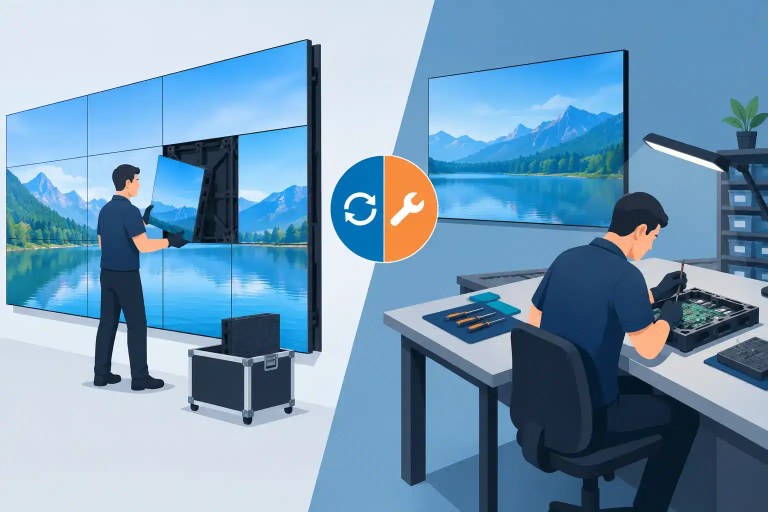
Before removing a module, compare the failure against known-good positions. If the fault follows the module when it is moved to another cabinet, the module is the likely source. If it stays in the same cabinet position, inspect the cabinet-side harnessing, power distribution, HUB board, receiving card, and connector condition before authorizing module repair.
This simple isolation step protects inventory. It prevents a good module from being sent out for repair while the actual problem remains in the cabinet. It also avoids reinstalling a repaired module into a system that has an unresolved power or signal fault capable of damaging it again.
Record the condition before disassembly
A serviceable module should arrive with useful context. Record the display brand and model, pixel pitch, module part number, cabinet location, serial number when available, and the reported behavior. Photograph the fault while the module is powered in the wall or on a controlled test fixture.
For rental inventory, note whether the issue appeared after transport, installation, weather exposure, impact, or a specific show. A module that fails intermittently after being flexed may require a different diagnostic approach than one with a constant color defect. This record creates a service history and helps identify recurring weaknesses across a batch of inventory.
Separate Module Faults From System Faults
Professional LED displays are interconnected systems. The module receives power and data, but its performance also depends on correctly configured control equipment, clean signal paths, stable power, and compatible firmware or calibration data. A module-level repair cannot resolve every display-level symptom.
When multiple modules show the same color, brightness, or mapping issue, begin upstream. Check processor output settings, sending and receiving card configuration, cabinet mapping, module parameters, and data cabling. If the issue appears across cabinets or follows a processor output, component-level repair of individual modules is unlikely to be the first answer.
Power-related symptoms deserve similar discipline. Random resets, flicker under bright content, sections that dim when white content is displayed, and failures that appear only after warm-up can involve power supplies, distribution boards, connectors, or current capacity. Testing only with low-brightness patterns may miss the condition that occurs during live operation.
There is also a practical middle ground. A module can have a genuine defect while a cabinet has marginal connections or an incorrect configuration. The most reliable service process identifies all contributing issues rather than stopping at the first visible failure.
What Component-Level Repair Can Address
Replacement is sometimes the correct choice, particularly when a module has severe physical damage, extensive corrosion, unavailable calibration data, or widespread PCB damage. But replacement is not automatically the most practical route. Matching modules may be discontinued, difficult to source, delayed by production schedules, or financially inefficient for a limited fault.
Component-level repair is appropriate when diagnosis identifies a repairable failure and the module remains structurally sound. Depending on the module design and condition, service can include pixel replacement, driver IC replacement, connector repair, damaged pad or trace repair, PCB-level correction, and precision rework of failed solder joints.
The distinction is critical. Replacing a visibly failed LED without confirming the driver output or circuit condition can produce a short-lived result. Replacing an IC without checking surrounding passive components, data paths, and solder integrity can do the same. Good repair work is based on the failed circuit, not just the most obvious symptom.
Microscope-level inspection is especially valuable for fine-pitch modules and dense assemblies, where lifted pads, cracked solder joints, damaged traces, and heat-related issues may not be visible during a basic bench inspection. Proper temperature control, component alignment, and soldering technique also matter because excessive heat or mechanical stress can create defects that do not appear until the module returns to field use.
Service the Module as Part of an Asset Strategy
For high-use rental or venue inventory, the question is rarely whether a single module can be repaired. The better question is whether repairing it improves fleet reliability, maintains visual consistency, and makes financial sense against replacement options.
A practical evaluation considers module age, failure history, availability of matching stock, severity of damage, required turnaround, and the display’s role. A spare module for a noncritical backup wall may be handled differently than a module from a touring package, casino feature wall, broadcast set, or flagship retail installation.
Repairing a small number of modules can be a sound decision when it preserves a matched inventory set. On the other hand, repeated failures from the same production batch may justify a broader inspection plan. If several modules show identical driver IC or connector issues, isolate the affected lot, test representative samples, and determine whether a preventive service effort is warranted before the next deployment.
This is where documented repair history becomes useful. Trends in failures can reveal handling damage, thermal stress, recurring power problems, environmental exposure, or a component weakness. Without records, teams may continue treating a pattern as unrelated one-off failures.
Quality Control Must Match Real Operating Conditions
A repaired module is not ready because it powers on. It should be tested with controlled patterns that expose the faults professional operators actually see. Full red, green, blue, white, grayscale, low-brightness content, and moving video patterns can reveal color imbalance, dead or stuck pixels, scan defects, driver inconsistencies, and intermittent data behavior.
Brightness and color uniformity deserve attention. Even a technically functional module can stand out if it does not match adjacent modules. The acceptable result depends on the application, viewing distance, pixel pitch, and wall content, but a high-visibility display requires a higher standard than a back-of-house utility screen.
Thermal and stability testing are equally relevant. Some faults appear only after the module reaches operating temperature or after sustained data and power load. Where practical, the module should be run long enough to identify intermittent failures before it is returned to inventory.
Documented QC gives the receiving team a clear record of what was found, what was repaired, and how the module was tested. For technical managers, that documentation supports inventory decisions and future troubleshooting. For operations teams, it creates confidence that the module has been evaluated beyond a basic power check.
Prevent Repeat Failures in the Field
Many module failures begin before the display is powered. Poor packing, unprotected faces, cabinet impacts, moisture exposure, bent connectors, and excessive handling pressure can all affect module reliability. Rental teams benefit from consistent packing procedures, visual inspection at check-in, and a clear process for tagging questionable cabinets before they are prepped for the next job.
During installation, avoid forcing modules into cabinets with misaligned hardware or damaged magnets. Inspect data and power connectors for bent pins, contamination, and incomplete engagement. When a module has been replaced or serviced, confirm configuration and calibration requirements before the wall goes live.
For permanent installations, watch environmental conditions and power quality. Heat, humidity, dust accumulation, vibration, and inadequate ventilation can turn a minor service issue into a recurring one. If a fault returns after repair, do not assume the replacement part failed. Revisit the conditions around the module and its cabinet.
725Co. approaches these decisions as technical service work rather than a parts-swapping exercise, using component-level diagnostics, precision repair methods, final testing, and documented QC to help professional teams make practical decisions about their LED assets.
The most useful service outcome is not merely a repaired module on the bench. It is a display system that returns to the field with a known fault resolved, its surrounding risks checked, and its next show, install, or operating day less dependent on chance.

Jose de Jesus Martinez (Chuy) is the CEO of 725co. LED Repair Professionals, a trusted name in high-quality LED module repair and video wall services. With over 12 years of experience and certification as an electronic engineer, Chuy has built a reputation for excellence, partnering with industry leaders. Under his leadership, 725co is known for precision repairs, transparent service, and a commitment to protecting the long-term value of LED investments.